
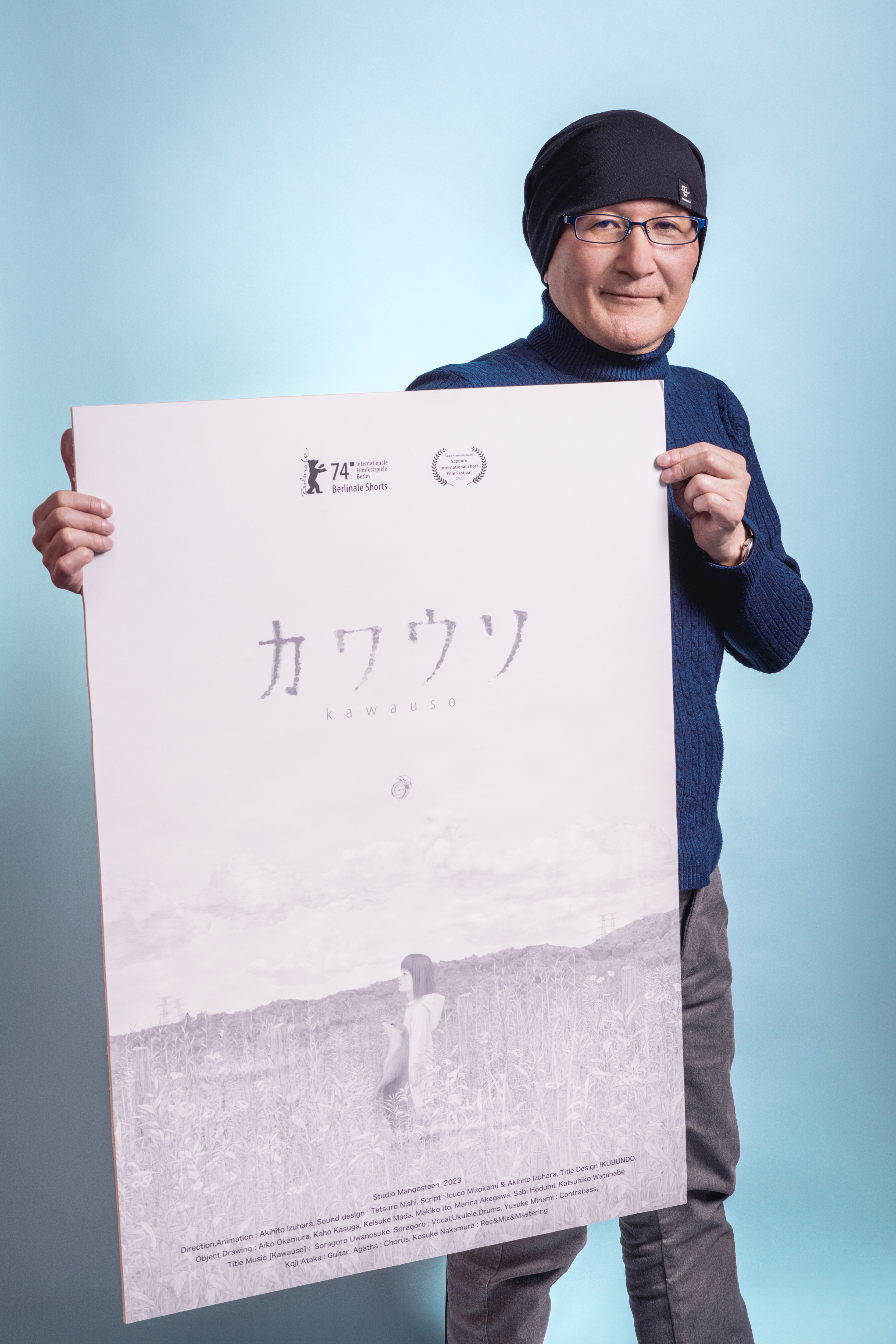
Born in the Gifu Prefecture of Japan in 1964, he has had video installations and exhibitions in Japan since 1990. In 2010, his film Akai Mori no Uta was the first work he presented at the Berlinale. In 2012, LI.LI.TA.AL screened in Berlinale Shorts; in 2016, Vita Lakamaya was his third film to screen in the Berlinale Shorts competition.
What was your starting point for „Kawauso“?
One of the reasons for this was the film’s theme song „Kawauso.“ It was a song by vaudevillian Uwanosuke Soragoro about the extinct Japanese river otter, and he approached me to make it into a film. At that time, I was searching for ways to approach the contradictions and hard-to-see violent aspects of the social structures of developed countries, including Japan. I thought that creating a story based on the relationship between humans and the Japanese river otter, an extinct species, would be an effective means of achieving this goal.
Do you have a favorite moment in the film? Which one and why this one in particular?
My favorite moment is the sequence where the girl puts her hand on the Japanese river otter’s head, and the paper bird flaps its wings. This is the only moment when the girl and the Japanese river otter come into contact, and the little bird that emerges from this moment rises as if to resist the falling motion that begins immediately after. And it is very weak and fleeting.
What do you like about the short film?
We remember various daily experiences as „stories.“ This shows that regardless of the length of time in a „story,“ what is important is how the fragments are connected. For me, short films are the best form to experiment with and control the associations of images.
******************************************************************************************
INTERVIEWS
interview with Akihito Izuhara for ARTE Kurzschluss
PRESS REVIEWS
„Ein Mädchen, mit Bleistift gezeichnet, sieht mich mit großen Augen an. Es ist still. Das Mädchen läuft los, einen Feldweg entlang, an dem es kleinere Geschäfte gibt, hinter ihr trabt ein japanischer Fischotter. Sie bleiben stehen, ein Stück Würfelzucker fällt vom Himmel.“
review by Robert Ide for Tagesspiegel
„The first warning sign is the lateral camera movement; instead of moving from left to right like in video games or hero quests, we watch a young girl walk from right to left. Followed by a curious otter, she stops at various stalls in the countryside, filled with finely rendered details, from old magazines and posters to faded awnings and lonely bicycles. We never hear a word from her as she conducts weird rituals – the sound even cuts out when she opens her mouth. But her actions invite a bizarre armageddon, Izuhara gloriously filling the frame with more and more chaotic things, all the while skillfully finding small yet satisfying details in each single, carefully thought-through stroke of his pencil.“
review by Redmond Bacon for Directos Note
„How lively the black and white animations of Akihito Izuhara ’s short film are becomes evident when the two main characters look wordlessly into the camera. Beforehand, the detailed and lively world unfolds in a single meditative tracking shot that follows the path of the silent protagonists. In the background, shops reveal their numerous goods, but nature literally sets the tone of the film. As unobtrusive as his entire style, Japanese folklore, mysterious events and environmental messages flow together in the contribution to the Berlinale Shorts.“
review by Paul Seidel for Riecks Filmkritiken
„the Japanese contribution “Kawauso” by Akihito Izuhara, who talks about saying goodbye with a little girl and an otter that has been considered extinct in Japan since 2012.“
mention in german by Doreen Kaltenecker for Testkammer
„Kawauso, Akihito Izuhara (Japan) A girl is strolling through the fields when a Japanese river otter catches up with her. The two try in vain to communicate while all the junk of humanity rains down around them.“
mention in Cartoon Brew
“ We hear a low rumble and a painful screeching sound, as the innocuous objects are joined by a handgun, a cannon, a bomb, planes, a grenade and finally, the biggest object, an atomic bomb falls to the ground. We cut back to the face of the girl who has placed her hands over her ears again and shut her eyes. The last scene is of the river otter walking through a debris-covered field and disappearing into the forest to the sound of a pop song grieving the extinction of the Japanese river otter. “I’m sorry I wasn’t able to protect your home” is one of the lyrics.“
mention by Isabel Roy and Verena Nees for World Socialist Web Site
******************************************************************************************
ETC.
„However, rather than expressing a call to action, the films capture a feeling. Kawauso, for example, turns out to be a deeply sad farewell song to the extinct Japanese otter. It does this by using an idiosyncratic cinematic device: whenever the protagonist wants to talk to the otter, the sound in the film cuts out completely. The two cannot communicate with each other because they do not exist in the same time plane.“
interview with section head Anna Henckel-Donnersmarck for Berlinale Topics
reactions on letterboxd
 Berlinale Shorts