
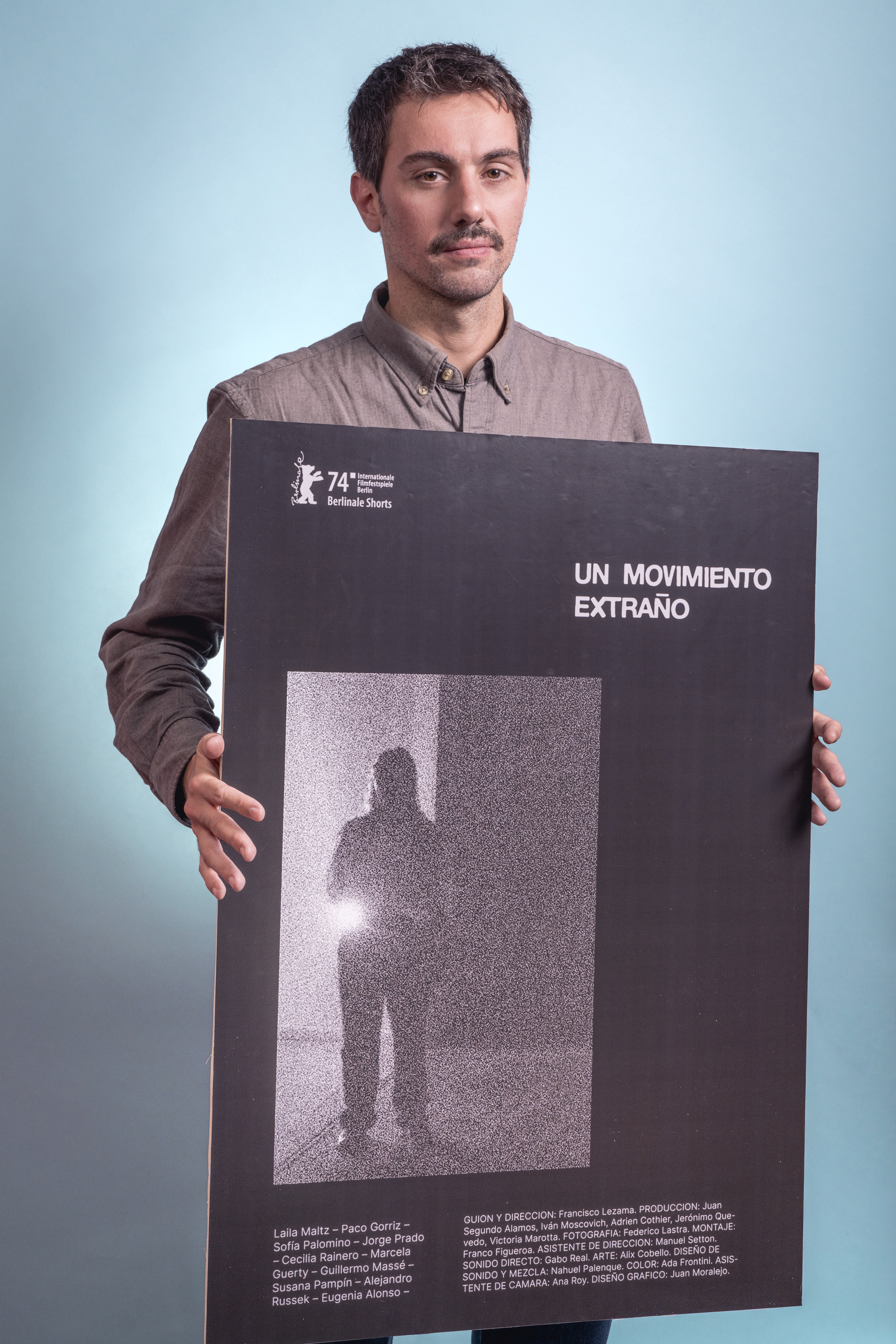
Born in Buenos Aires, Argentina in 1987, he studied film directing and acting. He teaches film history at the Universidad del Cine in Buenos Aires and has worked at the Museo del Cine film archive since 2012. His short films have screened at Locarno, the New York Film Festival, the AFI, the Viennale and many other festivals.
What was the starting point for “UN MOVIMIENTO EXTRAÑO”?
I began shooting the short in late 2019 and had to stop because of the pandemic. At that moment, I wanted to continue writing comedies about Argentina’s obsession with saving in dollars. Money in movies has always interested me; I like the way it hypnotizes the characters. Recently, an anarcho-capitalist was elected president of Argentina. One of his campaign promises—which had a great impact on young lower-middle-class workers—was to eliminate the Argentine currency (the peso) and replace it with the dollar. I began writing about characters that are obsessed with the dollar in 2014, and today, ten years later, the madness seems total. Our country is called Argentina, which means silver (argentum). We call money “plata” (silver). The hypnosis seems total, as though it were a film by Fritz Lang.
Is there any moment you consider to be your favorite? Which one is it and why?
Before the pandemic, I spent some years working at a movie theater that operated inside a museum. At night, the museum would close, but the cinema remained open. So the only ones left were the security guards and me, with the low lights and the empty museum. I liked what went on with the bodies of those of us working in customer service when we were alone. There was something “theater of life”-like or, rather, “theater of work”-like in the way we would loosen up when no one was looking. One night, I had the chance to see the works of Pablo Suárez (Buenos Aires, 1937-2006) in a pitch-black room lit by flashlights, and then I knew I had to shoot a fiction that would capture that atmosphere in which I had worked. Those are my favorite moments in the short.
What is it you like about the short?
I think short films are only worth it when they understand that they are strange, unnecessary objects. They tend to have fewer resources—it’s more of a DIY (Do It Yourself) kind of situation. In Argentina, we refer to improvising cheap but effective solutions as “atar con alambre” (tying with wire). The aesthetic that comes from “tying with wire” is something I like very much, and I think it tends to happen more when making short films. This year, I will be shooting my first feature, and I hope that DIYer shrewdness doesn’t disappear.
***************************************************************************************
Interview by Knut Elstermann for radioeins
„Un movimiento extraño arises from the desire to combine several quite dissimilar ideas. When I write I work on ideas that I accumulate on cards over a period of time. As I grow fonder of them (none is more important than the other), the work consists of putting together a script structure that prevents any of those ideas from being left out. In this way, the “sitcom” usually emerges afterwards; a genre that enables the coexistence of different and chaotic ideas. I think this method of writing opposes the thesis. I never start from an assumption or a hypothesis and I never arrive at any position, confirmation or thesis. In my particular case I prefer to work with atmospheres. In A Strange Movement in particular, many of the cards I worked with revolved around the crisis and currency runs. One of the cards I worked with said: “a security guard senses a robbery, but upon consulting his pendulum she foresees an abrupt rise in the value of the dollar.” That token with other tokens guided the short.“
Interview by Laura Vitali & Fernando E. Juan Lima for escribiendocine
„I always had a rather strange and irregular writing method . I work with cards, a file method, like a collection, collection of ideas. I have many files in my house. I love taking notes, sometimes I do it on the phone or sometimes I do it on physical index cards. The ideas I write down are broad: they range from a narrative device to a type of shot cut, something I observed in a film, a philosophical, sociological, abstract idea or something very concrete, whatever.“
Interview by Matías Kirjner for desbandada
***********************************************************************************************
JURY STATEMENT for Golden Bear for Best Short Film
„How do you find your way as a young person in a world that provides no security? Do you become a security guard yourself? Do you expose yourself to art, casual sexual partners, or perhaps seek spirituality and try to see into the future?” Francisco Lezama demonstrates sharp insight into the dynamics between young people and society, adeptly highlighting social issues without resorting to accusation. Through the protagonist’s 22-minute journey, the film brims with vitality, wry humor, and nuanced social commentary, all encapsulating the absurdity of our capitalist times. This film thoroughly impressed the jury with its cleverness, youthful insight, and masterful craft. This year’s Golden Bear for Best Short Film goes to Francisco Lezama’s Un movimiento extraño.
The Awards and Jury of Berlinale Shorts
**********************************************************************************************
PRESS REVIEWS
„“Un movimiento extraño“ is a comedy set in Buenos Aires and the plot revolves around a security guard who foresees a sharp rise in the dollar and ends up falling in love with an employee of an exchange house.“
review in Spanish by Sofía Cereceda for emol
„The story presents two characters who apparently have a bond, but they don’t, because ultimately it’s just about a girl with dollars and a boy without dollars.“
mention in Spanish at Clarín
With „Un movimiento extraño“, he provides a critical and humorous look at the economic reality of the country, highlighting as a central theme the figure of the “little tree” and speculation with foreign currency.
review in Spanish by Noelia Gomez for infobae
„I wanted to make a “ deconstructed romantic comedy ” based on this idea that there are two types of Argentines, the middle and upper middle class, who have the rest of their salary to convert into dollars, and “then they save themselves and live in a selfish fantasy that has to do with wanting the dollar to increase,” while the lower class cannot, it is drained.“
review in Spanish by Elena Garuz for Crónica
„The Argentine film “Un movimiento extraño”, by Francisco Lezama, won the Golden Bear this Saturday from the short film jury at the 74th edition of the Berlinale.“
review in Spanish at elDiaro.es
Winner of the Golden Bear for best short film at the Berlin Festival, „Un movimiento extraño“ makes a curious but very accurate and original combination between sexual desire and the value of the dollar.
review in Spanish by Diego Lerer for Micropsia
„Lezama’s proposal not only addresses a topic relevant to Argentine society, but also, through its inclusion in an internationally renowned film festival such as the Berlinale, positions Argentine cinema on a global stage, allowing for a broader dissemination of his social criticism.“
review in Spanish by Noelia Gomez for infobae
„According to the jury, the filmmaker shows in this film a „sharp perspective on the dynamics between young people and society by skillfully highlighting social problems without resorting to accusation“ through the protagonist’s 22-minute journey.“
review in Spanish at abc
„Francisco Lezama made history: his short film „Un movimiento extraño“ won the Golden Bear at the Berlinale Shorts at the 74th edition of the Berlin International Film Festival – Berlinale, which presented its awards on Saturday the 24th.
review in Spanish at GPS audio visual
„When he went on stage to receive his award, Lezama was categorical in his dedication: “I would like to thank the National Film Institute (INCAA), which is being very mistreated by President Javier Milei”.
And he continued: “I would also like to thank other public institutions that are not as well-known as INCAA but that also educated me for a long time. To the Buenos Aires Cinema Museum, to the ENERC Library, where I was going to read a lot. To the Fernando Martín Peña program (Filmoteca, which was broadcast on Public TV until 2023). These are public institutions that are at risk at this moment because everything is measured in economic terms. and if it does not generate money they simply close it.”
review by Lisa Harris for 24 Hours Worlds
„The director said that his film is a project that he began filming in 2019 and „stopped due to the pandemic,“ and that at one point he „almost abandoned.“ „It is a short film that narrates the Argentine state of crisis regarding having to save dollars to set fees ,“ he said.“
review in Spanish at pagina12
„[„Un movimiento extraño“] is a sad comedy about the economic crisis in Argentina set in Buenos Aires in 2019.“
review in Spanish at LaVoz
„Lezama’s film is a comedy that deals with a museum security guard, who predicts the rise in the value of the dollar in her country, and after being expelled from her workplace, she is unexpectedly compensated.“
mention in Spanish at Rialta
„The new title from the author of “The Bride of Frankenstein” (which participated in the 2015 Locarno Festival) and “Dear Renzo” (winner of the Bafici 2017) […] is a comedy set in Buenos Aires Aires in 2019 […]“
review in Spanish at ElDiaro
„„An Odd Turn“ konnte den Hauptpreis für den Besten Kurzfilm erhalten. Darin erzählt der argentinische Regisseur Francisco Lezama von dem Zwischenmenschlichen und diversen Jobs in der flirrenden Hitze der Stadt Buenos Aires.“
mention in German by Doreen Kaltenecker for Testkammer
„the filmmakers refer to the severe financial crisis rocking Argentina since 2018. According to director Lezama, he didn’t want to release his film straight away for fear it would be perceived as too cynical. Now, however, with the brutal austerity policies of the new far-right president Javier Milei, the film is very topical. There is hyperinflation of over one hundred per cent in Argentina, in a country where around half of the population officially live in poverty. People quickly convert the pesos they earn into dollars to double or triple their salaries thanks to rising exchange rates. „
Review by Isabel Roy and Verena Nees for World Socialist Web Site
*******************************************************************************
ETC.
„Un movimiento extraño schildert mit trockenem Humor die Lebensumstände in Buenos Aires vor der Pandemie.“
interview with section head Anna Henckel-Donnersmarck for Berlinale Topics
reactions on letterboxd
 Berlinale Shorts