
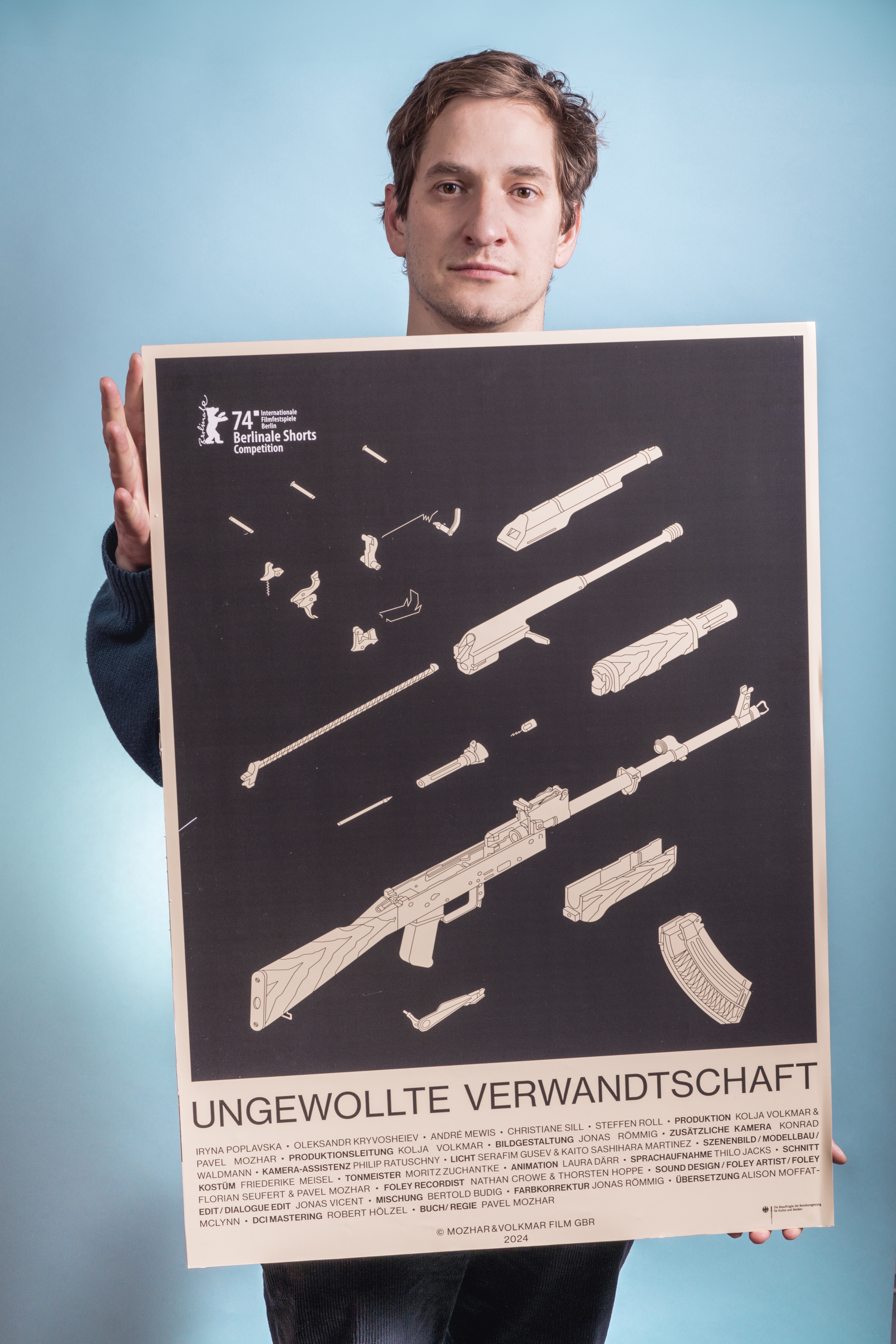
Born in Minsk, Belarus in 1987, he grew up in and around Berlin from the age of ten. From 2009 to 2012, he studied philosophy and economics at the University of Bayreuth. In 2015, he took up a film directing degree with a focus on documentary at the Film University Babelsberg Konrad Wolf. His short documentary Handbook, about the protests in Belarus in August 2020, won numerous awards, including Best Short Film at the IDFA in 2021 and at the Kurzfilm Festival Hamburg in 2022.
What was your starting point for „Ungewollte Verwandschaft“?
When the first reports about the war crimes committed by Russian and Belarusian soldiers were published, I realized that it was the same spiral of violence that I had already dealt with in my previous short film, only this time much worse.
Do you have a favorite moment in the film? Which one and why this one in particular?
Hard to say. I like the sequence in the garage street – that was a good day’s shooting.
What do you like about the short film?
I like the rigor of the short format. A short has to be condensed and therefore has a strong focus. A short has no time for side issues and digressions – unless that is its focus. So it is experimental, but never arbitrary.
*************************************************************************************
PRESS REVIEWS
„Attempting to grapple with difficult ideas is also present in the German Unwanted Kinship by Pavel Mozhar (2024, above), a Belarusian filmmaker who has lived in Berlin since the age of ten. The film takes testimony from Ukrainian civilians caught up in the Russian invasion, detailing the abuse and violence they suffer. Alongside this are re-enactments, some handled by actors in disused post-industrial settings, and some by a collection of small plastic action figurines. Both of these re-enactments avoid any visual representation of violence, which is present only in the testimony read out by actors. In addition, Mozhar narrates his own experiences in German as opposed to Russian or Belarusian. He speaks of a sense of disgust (the unwanted kinship of the title) at those who commit acts in the belief of an imagined community, of which Mozhar is contiguous.
It’s a fascinating and aesthetically tricky depiction of complicity, and to what extent one can conceive of collective guilt. In and of itself, the film is superb.“
review by Fedor Tot for Journey into Cinema
„Das Dokumentarische und die Inszenierung sind auch Bestandteile beim neuesten Film von Pavel Mozhar („Handbuch“): In „Ungewollte Verwandtschaft“ beschäftigt er sich diesmal mit seiner erprobten Art des Nachstellens mit dem der russischen Invasion in der Ukraine. „
mention by Doreen Kaltenecker for Testkammer
„Spielplätze seien am schlimmsten, bemerkt eine der erzählenden Stimmen zu Beginn der knapp halbstündigen Kriegs-Konstruktion. Auf den Spielplätzen wurden viele Leichen begraben. Der weiche Sandboden bietet sich dafür an. Die verstörende Anekdote ist nur eine der Gräuel, die mit sachlicher Nüchternheit in dem minimalistischen Memorandum im Programm der Berlinale Shorts berichtet werden, aber länger im Gedächtnis bleibt als die übrigen.“
review by Lida Bach for moviebreak
In the film „Unwanted Kinship“, director Pavel Mozhar explores his childhood in post-Soviet Belarus. Using reports from human rights organisations, he documents what happened when the Russian army and Belarusian troops withdrew from some of the occupied territories shortly after the start of the full-scale invasion of Ukraine. The victims‘ accounts are spoken by Ukrainian actors and the atrocities are re-enacted in Berlin. The question arises as to what role the filmmaker himself plays and what responsibility he bears as a Belarusian.
mention in german by Dominique Hensel for Weddingweiser
*******************************************************************************
ETC.
„I think it’s to do with the sincerity with which the films are made. And the willingness of the filmmakers to let other people share in their lives, joys and fears, and also their doubts and vulnerability. I’m thinking of Ungewollte Verwandtschaft„
interview with section head Anna Henckel-Donnersmarck for Berlinale Topics
reactions on letterboxd
 Berlinale Shorts