
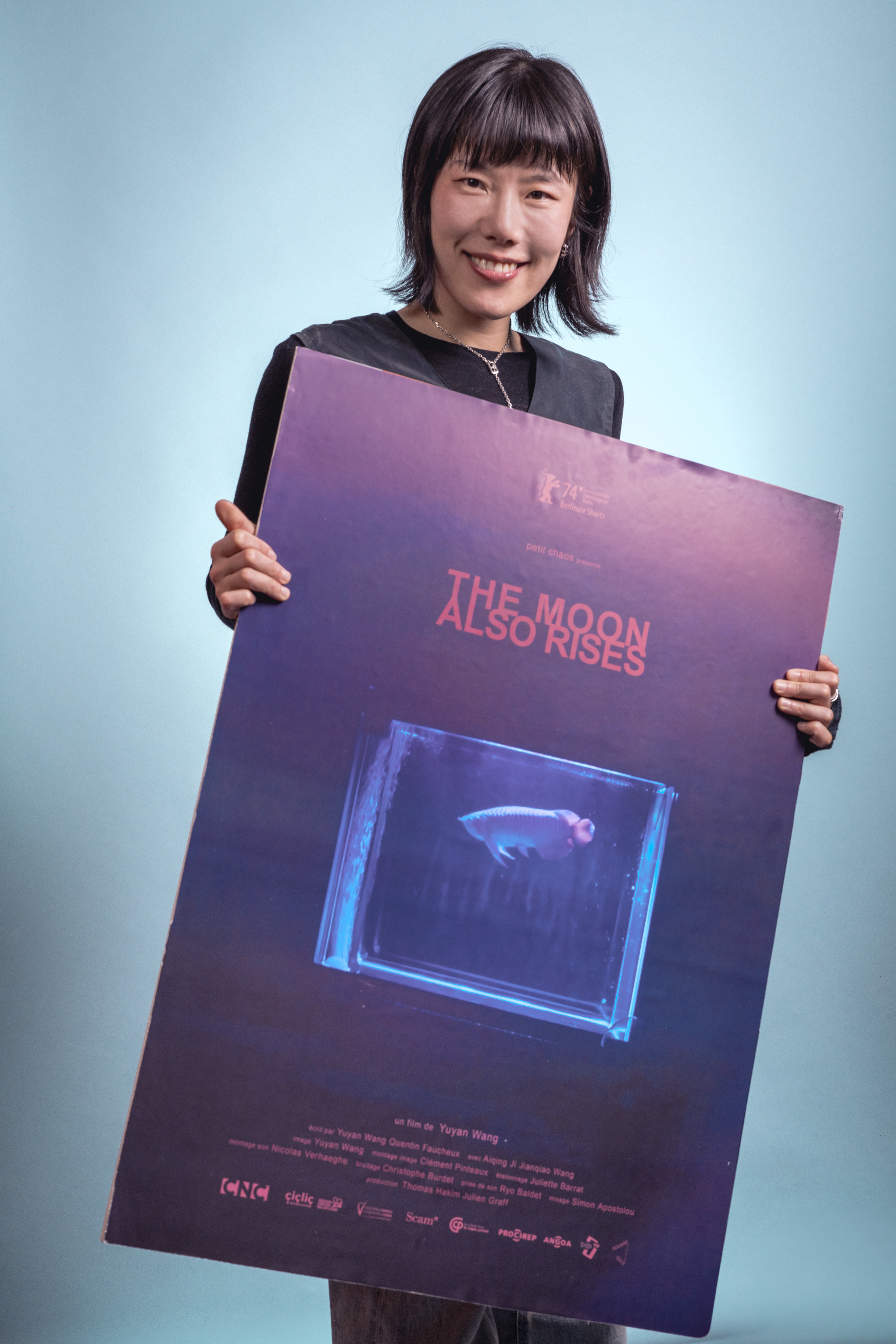
Born in China in 1989, the filmmaker and multi-disciplinary artist studied at the École nationale supérieure des Beaux-Arts in Paris and at Le Fresnoy – Studio national des arts contemporains in Tourcoing. Her work, which focuses on the continual mutations within the industrial production chain of images, has been presented at Tate Modern, Palais de Tokyo, the 12th Berlin Biennale and various festivals and has won numerous awards. One Thousand and One Attempts to Be an Ocean screened in Berlinale Shorts in 2021.
What was your starting point for “The Moon also Rises”?
In 2018, a group of Chinese scientists announced a project of artificial moons. They were intended to be launched into orbit in 2022 above certain major cities in China with the intention of blurring the lines between day and night. The news was extensively broadcast on social media at the time, yet these mystical moons were never launched, and no further updates have been given, leaving only scattered information echoing in the internet archives. However, in a way, these artificial moons—or the idea of constant visibility and connectivity they embrace—have long been part of our reality, albeit in a different form through our omnipresent digital devices. Collectively, we intimately experience this enduring connectivity through countless luminous tools, each seamlessly extending ourselves and acting as a prosthesis enabling us to perceive everything from anywhere.
In a modest way, I try to open a parenthesis around this phantom project, to imagine an intimate domestic space illuminated by the flickering rays of the contemporary technosphere. Within this space, a stream of recontextualized information blends with the daily routines and mundane moments of my parents‘ lives during quarantine. This fusion parallels their efforts to keep up with the pace of modernity, in an era where traditional concepts of time appear to dissolve. For me, it’s a letter to our opaque and fragile selves, caught in an era obsessed with constant visibility transparency, and connectivity.
Do you have a favorite moment in the film? Which one and why this one?
It’s quite difficult to choose the highlight moment of this film, as its energy is modestly low-fi and composed of a chain of micro-events existing within its supportive context. However, every time I reach the final scene where my father bifurcates the darker path in the tunnel, I still feel a surge of emotion. This scene evokes a lot of memories of the shoot: it was just my father and me—he holding a torch and I with my camera—walking in silence through a vast labyrinthine abandoned tunnel. Certain minerals became phosphorescent, transforming the industrial ruin into a prism—a scintillation of darkness perceptible only to our eyes, despite the advanced light-sensing techniques of the camera. I still remember the heart palpitations when confronting this ancient opaque lithic era, where our most futuristic visions are grounded, as if we are tracing the light back to its earthly origins.
What do you like about the short form?
I like the short form for its potential to allow us to drop our guard on the plot conflict and linear logic. Somehow we need to condense our expression into a minimal formula and trust readers to fill in gaps in understanding with varying emotional investments and interpretations. Short films rely on the unspoken and imagination.
*******************************************************************************************************
INTERVIEW
„My parents moved to this new house while I was living abroad. I later discovered this strangely styled space, superficially imitating the West with very saturated plastic decorations. The previous owner had left an Arowana fish, which my father took under his wing, developing an obsession with light decorations around the aquarium, which now serves as a lamp for the living room. This gives an almost documentary dimension to the staging. It was truly their home, marked by their daily activities.“
interview by Nicholas Bardot for Le Polyester
*******************************************************************************************************
PRESS REVIEWS
„Computer voices and the light from screens and neon tubes take over the language of the reclusive main characters, who rarely receive any news from the outside world, unless artificial moons are to be launched into space. With few resources, a hypnotic look into a dystopian future is created, not too far removed from the current zeitgeist. Elegiac and occasionally experimental – twenty-four minutes of science fiction that once again show what is possible with manageable effects and backdrops.“
mention by Paul Seidel for Riecks Filmkritiken
„“Time is just a feeling. You can overcome it. And then move on.” This is what a voice says in the French-Chinese film “The Moon also rises”. It consists of a camera monitoring an aquarium with fish while a man looks at his cell phone. A voice from the off speaks: “Imagine yourself falling – without there being a bottom.”“
review by Robert Ide for Tagesspiegel
„Sind wir alle nur Pixel bewusstseinsloser Bilder einer Welt, die sich durch die andauernde Reproduktion und Reduplikation ihrer digitalen Duplikate in eine abstrakte Aufnahme ihrer selbst verwandelt? Sind wir nur Phantasieprodukte künstlicher Intelligenz, ohne eigene Absichten und Gedanken? War das ein Goldfisch in einem Eiswürfel? Sind die blauen Flackerlichter Nahaufnahmen einer Plasmalampe?“
review by Lida Bach for moviebreak
*******************************************************************************************************
ETC.
„The Moon Also Rises describes an atmosphere that could be interpreted to be the one in China during the pandemic“
interview with section head Anna Henckel-Donnersmarck for Berlinale Topics
reactions on letterboxd
 Berlinale Shorts