
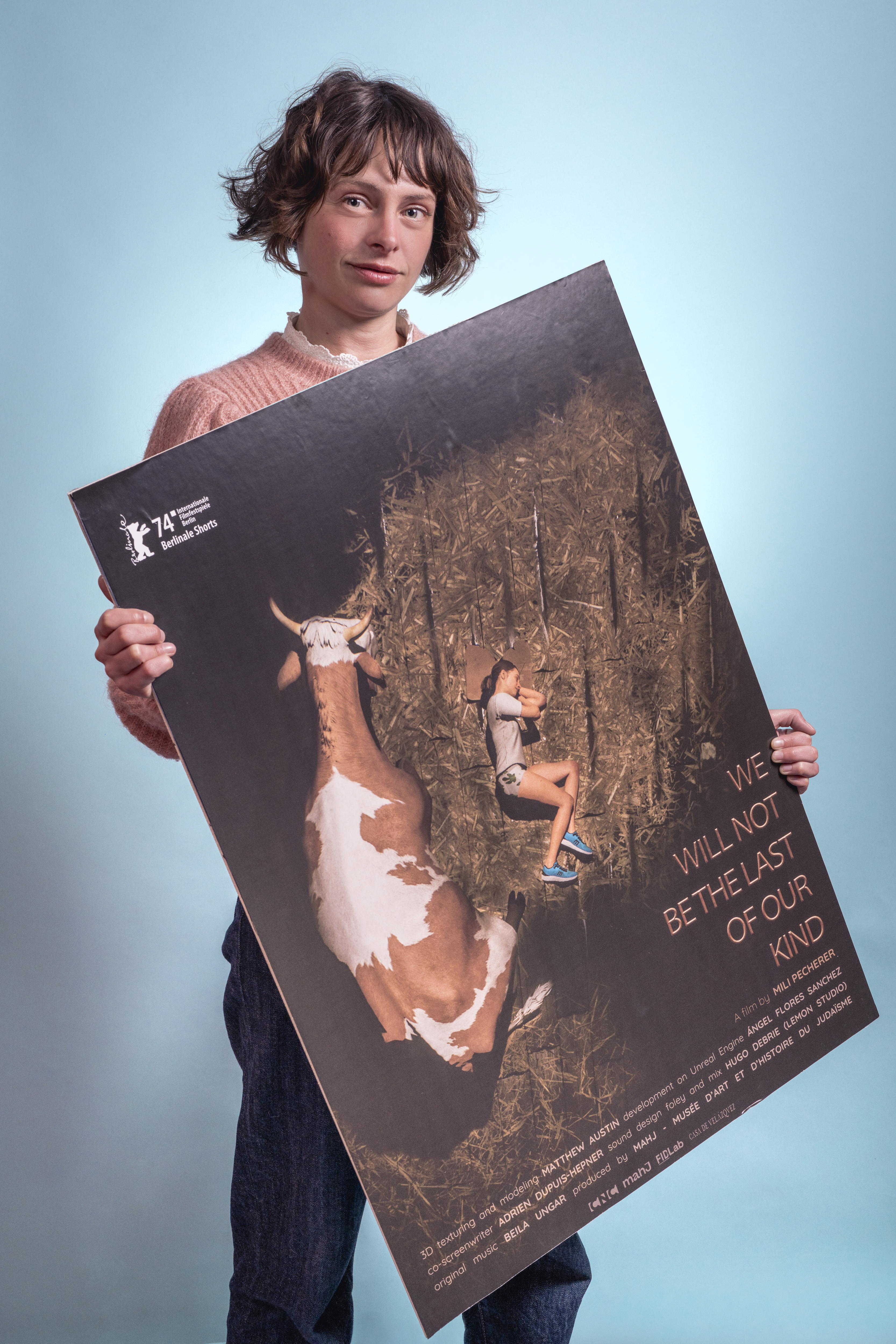
The director, who was born in Israel in 1988, claims to have made films with Napoleon Bonaparte, God, a haemorrhoid and a donkey before adopting video game technology to obtain a new narrative freedom. Her work takes on the great biblical tales and confronts them with her own questions. She is a graduate of the Bezalel Academy of Art and Design in Jerusalem and Le Fresnoy art school in Tourcoing, France. She currently lives in Marseille. Her film It Wasn’t the Right Mountain, Mohammad screened in Berlinale Shorts in 2021.
What was your starting point for “We Will Not Be the Last of Our Kind”?
I was unemployed. Once again. Once again, I found myself living through that anxious time of not knowing what I was doing with my life, if I’d ever make another film, and how to earn money. I guess that was the starting point. Eventually, I landed a job through a professional integration program designed to guide lost souls like me—or immigrants—toward becoming contributing members of society. We were promised it’d bring us peace of mind and show us how to keep our fridge fully stocked. I was assigned to a construction site, as part of a carpentry team, on an island near Marseille. Every morning, I had to take a boat to get there. I was quite happy at first. I liked my team, I thought I was about to learn a new profession, received a modest monthly salary, and, at last, I had an answer to the torturing question of “so what are you doing these days?”. I even felt relieved not to dwell on making films anymore. But gradually, things took an absurd turn. Our tasks were vague, seemingly pointless, designed to keep us occupied. Our primary duty seemed to be waking up before dawn, always being on time, complying without questioning, ignoring the search for meaning, refraining from personal inquiries, and not discussing matters of faith. Drinking ourselves into oblivion was a common ritual on our way home. Then, as life sometimes surprises you when you’re ready to give up, an opportunity to create a film presented itself. I chose to craft a film about Noah’s ark and the great flood. The challenge, however, lay in its status as perhaps the most famous story globally, interpreted countless times. Finding my own personal angle was tough. I knew the original text involved a rebellious raven, a pretentious dove, and a few pairs of ‚pure‘ animals. But how did these animals end up there? What compelled them to abandon their wilderness and freedom to heed some human’s call onto a colossal wooden vessel? I wrestled with this question until my friend and artist Cindy Coutant suggested that my ark could be a professional integration program too. Suddenly, it clicked. These animals agreed because they were promised, too, that joining this program, boarding the ark, would bring them peace of mind—no more worries about stocking their fridge. They’d finally become ‚Pure’—Productive, Useful, Resourceful. And thus, the adventure began.
Do you have a favorite moment in the film? Which one and why this one?
Perhaps my favorite scene in the film is the one where I’m having a conversation with the raven next to the coffee machine, seen from the perspective of the aquarium. It’s the only real and intimate dialogue in the entire film. While I interact with the dove, who serves as our supervisor in the integration program, and address the audience, there’s no real two-way communication. The raven also speaks during the film, but sadly, nobody listens. Yet, in this particular scene, we engage in a real intimate conversation, revealing parts of ourselves. He tells me things I would have loved to hear in real life. Calling me to rebel.
What do you like about the short form?
The process of making this film was so complex and nerve-wracking that I believe if it had been any longer, I might have ended up like my avatar did in the film. So, short is good for staying alive.
****************************************************************************************************
INTERVIEWS
„We Will Not Be the Last of Our Kind is a strange UFO: it is a rereading of Noah’s Ark, which would be transformed into a sort of professional reintegration program for its young heroine working among animals. Israeli Mili Pecherer combines apocalyptic tension and an absurd sense of humor in a very surprising way in this short film in competition at the Berlinale . In the stiffness of the computer-generated images, an intriguing light seems on the verge of flickering. Mili Pecherer tells us more about this strange existential tale.“
intro to the interview by Nicolas Bardot for Le Polyester
„J’ai lu l’histoire biblique comme des règles d’un jeu, en me créant un cadre de contraintes. Parce que sans contraintes, tout est possible et donc tout est impossible… d’une certaine manière. C’était un peu compliqué parce que c’est l’histoire la plus connue et la plus travaillée, et il fallait que je me trouve un petit coin où je sois à l’aise, où je puisse chercher mes propres interrogations contemporaines.“
excerpt from an interview by Amel Argoud for Format Court
We Will Not Be the Last of Our Kind is a strange UFO: it is a rereading of Noah’s Ark, which would be transformed into a sort of professional reintegration program for its young heroine working among animals. Israeli Mili Pecherer combines apocalyptic tension and an absurd sense of humor in a very surprising way in this short film in competition at the Berlinale . In the stiffness of the computer-generated images, an intriguing light seems on the verge of flickering. Mili Pecherer tells us more about this strange existential tale.
interview with Nicolas Bardot for Le Polyester
**********************************************************************************************************
PRESS REVIEWS
„Was, wenn die berühmte Arche Noah, auf der Mensch und Tier Zuflucht vor der Sintflut fanden, nicht bloß ein Akt göttlicher Intervention war, sondern ein sorgfältig geplantes Programm zur beruflichen Wiedereinglie-derung?“
mention in Tagesspiegel
„French animation We Will Not Be the Last of Our Kind (Mili Pecherer, 2024), developed in the Unreal game engine, looks like a point-and-click adventure game c. 2005. Set on Noah’s Ark, it repurposes the Biblical story to one of logistics and bureaucracy, our human protagonist ordered to do meaningless tasks by middle management (mostly birds). Refracting the Book of Genesis through modern capital’s propensity for bullshit jobs mediated and overseen by bullshit people is certainly a novel and ingenious idea — I only wish Pecherer went further with it, and imploded the thought: the film is awkwardly tame for its brilliant hook.“
mention by Fedor Tot for Journey into Cinema
„ing a realistic aesthetic, this is a tellingly dark examination of abuse and regret, all set within a dystopian world. With machinima being popular within the world of shorts thanks to the likes of directing collective Total Refusal, Mili Pecherer’s We Will Not Be the Last of Our Kind (France) re-imagines the narrative of Noah’s Ark as a corporate restructuring of humanity. Utilising modern video-game aesthetics, the film deals with the clash between the old moral certainties of religion and the modern uncertainties of capitalism in an often-satirical take on modern viewpoints.“
mention by Laurence Boyce for Cineuropa
„Cette arche de Noé moderne illustre cette perte de sens, notamment en suggérant l’exploitation par le travail caractéristique d’une société capitaliste. Plusieurs fois, un oiseau répète que les heures supplémentaires de la femme seront payées davantage, et que le frigo sera enfin rempli. N’y aurait-il pas une pointe d’ironie de parler de salaire quand c’est la fin du monde au dehors ?“
review by Amel Argoud for Format Court
„What are men up to? Are they absent from themselves?“ Die Fragen wirft Mili Pecherers abergläubisches Animationskino nicht nur wörtlich in den doktrinären Dialogen auf. Was die Regisseurin von den Titeln nach inhaltsverwandten Werken wie It Wasn’t the Right Mountain, Mohammad und How Glorious It Is to Be a Human Being und Sprecherin der einzigen menschlichen Rolle mit ihrer bebilderten Bibelstunde im Sinn?
review by Lida bach for moviebreak
„What if the famous biblical ark, the last refuge of humankind and the animal kingdom during the great flood, was not merely an act of divine intervention but, instead, a meticulously planned program for professional reintegration?“
mention in Cartoon Brew
**********************************************************************************************************
„We have, for instance, a “machinima” in the programme, which is a film shot in a computer game. As was the case with It Wasn’t the Right Mountain, Mohammad, which we screened in 2020, the director for We Will Not Be the Last of Our Kind built this computer game world herself and entered into a story from the Old Testament as a contemporary avatar.“
interview with section head Anna Henckel-Donnersmarck for Berlinale Topics
reactions on letterboxd
 Berlinale Shorts