
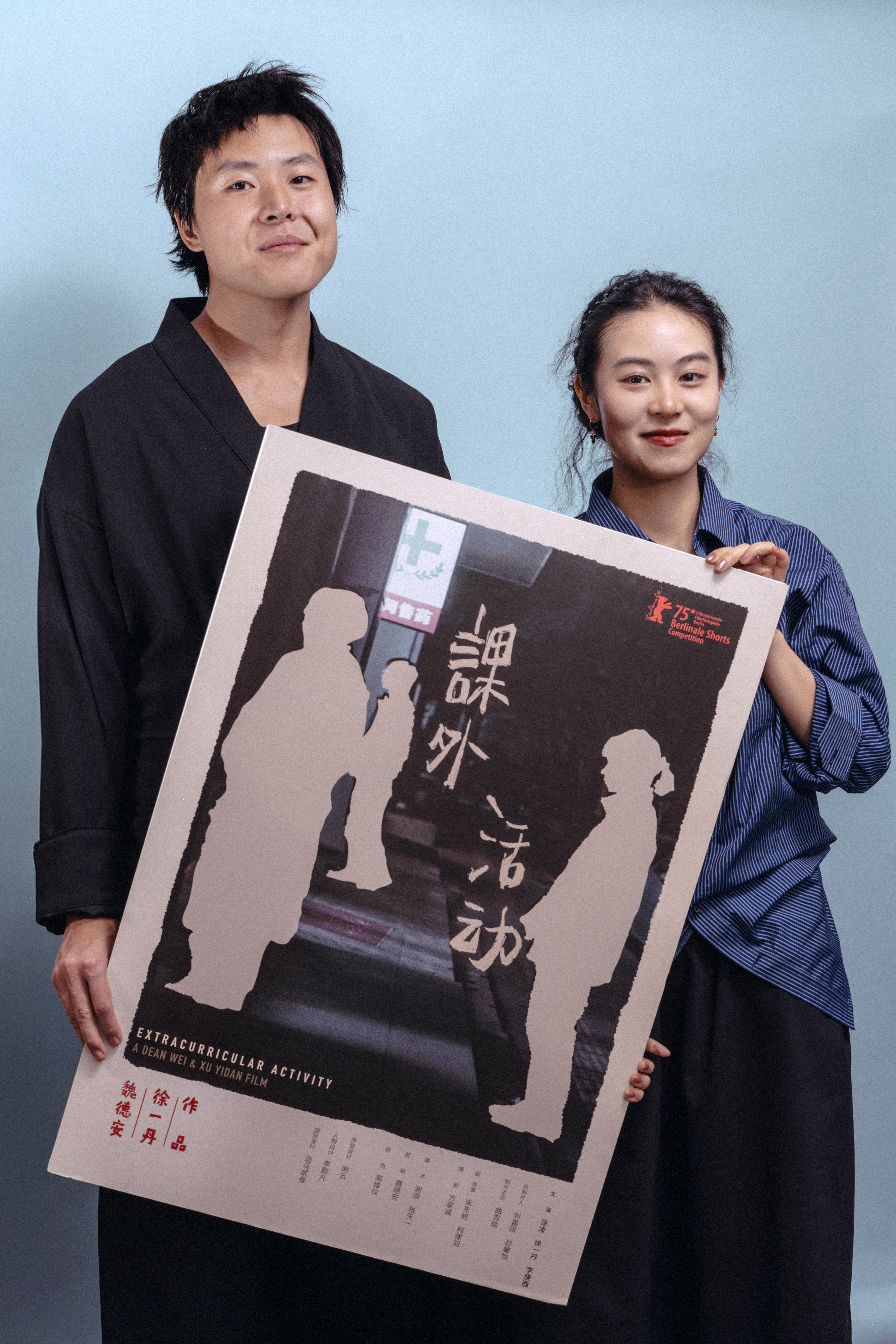
Dean Wei
Born in Cologne, Germany, the filmmaker, composer and cinematographer studied cinematography at the Beijing Film Academy. He currently lives in Beijing.
XU Yidan
The director, writer and actor is from Chengdu, China. She studied cinematography at the Beijing Film Academy and currently lives in France.
What was your starting point for „Ke wai huo dong“?
The character of the mother was the first one to manifest. We know real people quite like her: suburban life, chunky SUVs, gated communities. It all sounds a bit cliché but it’s not uncommon for them to have trouble holding their children’s leash. We were interested in exploring a conflict in which the character’s role as a mother clashes with her role of being a woman. As we dug deeper, the character of Xu Yidan became more prominent, and we ended up shifting the point of view from that of the mother to having no point of view at all. Which in itself is an impossibility in the medium of film, but the idea behind it was to adopt as much of an observational approach as possible with only little artifice or cinematic trick.
Do you have a favorite moment in the film? Which one and why this one in particular?
Dean Wei: My favorite scene is the one where the boy’s mother goes to the bathroom to check on the girl. The part plays out a bit like a hide and seek, and you feel the tension between the characters change, even though they’re not in direct line of sight of one another. I’ve always liked the idea of the “frame” in films, especially when characters disappear off frame but their presence still somehow “hangs in the air.” It’s almost like we’re witnessing something we’re not supposed to be seeing.
Xu Yidan: My favorite scene is at the end of the film, as the day dawns, and the boy’s mother gently leads the girl away from an oncoming garbage car. This particular scene adds a bit of grayness to their relationship. The film is all about unspoken words and the actions that result from those silent stretches.
What do you like about the short form?
Dean Wei: A short film is a different canvas, but not necessarily a smaller one. Most of the revelations I’ve had of cinema have come from watching shorts. The language is concise and carries such urgency that every shot, every line, every piece of information has to be justified. It’s a bit like songwriting.
Xu Yidan: I like how the short form limits information. Making a short film is like arranging a 10-square-meter room. How can I use the space efficiently while still making myself comfortable? It’s a different sort of discipline to create hidden corners and to get rid of anything that doesn’t fit.
*************************************************************************************
INTERVIEWS
„Xu Yidan: […] From the very beginning, I just wanted to make a film that asks a question. I didn’t want to impose a specific value judgment or tell the audience what to think or do. […]
Dean Wei: […] In my opinion, the only real difference between commercial films and arthouse films is that commercial films provide an answer, while arthouse films leave you with a question. Our film is a question mark—I don’t think we are in a position to answer it because we ourselves don’t have the answer.“
interview at https://mp.weixin.qq.com/s/kZpLbQaSDskX1Ogf6-lsMQ
*************************************************************************************
PRESS REVIEWS
„This Chinese film is highly deliberate and slow, almost documentary-like in its portrayal of a late-night trip to the pharmacy to avert an emergency, yet it burns with great intensity thanks to a highly-focussed performance by Tu Ling as a mother immediately taking the reins in the wake of a disaster. Hypnotically assured.“
review by Redmond Bacon for Journey into Cinema
„The short thrives on its technical aspects. The cinematography by Fang Jiacheng is impressive, with the ‘double frames’ (the one with the trees and the lovers and the one with the son in the aquarium and the mother moving in the house) definitely standing out. The close-ups are used in a way that adds to the aesthetics of the movie, and are definitely not overused, while the scenes in the car allow all the protagonists to stand out. Dean Wei’s editing results in a relatively fast pace that also works well, and also allows the directors to suggest and imply what is happening, without spoonfeeding their audience, in a rather smart approach.
“Extracurricular Activity” is a well-shot, very smart in its comments short, that highlights the prowess of all those who were involved in it, directors, cast and crew.“
review by Panos Kotzathanasis for Asian Movie Pulse
„Selbst in den verhaltenen Dialogen tut sich Sprachlosigkeit auf. Das Schweigen breitet sich aus. Dabei vermutet man nicht unbedingt Desinteresse. Einfach macht es der Film dem Publikum nicht, aber er wirkt nach.“
review by Elisabeth Nagy for Riecks Filmkritiken
„Présenté en compétition, Extracurricular Activity est une nouvelle découverte remarquable du jeune cinéma chinois. Dean Wei et Xu Yidan construisent un récit elliptique qui parvient à être à la fois très direct et très pudique. Remarquablement mis en scène, Extracurricular Activity surprend également par l’écriture de ses personnages dont les dynamiques et interactions évitent intelligemment les clichés.“
review by Nicolas Bardot & Gregory Coutaut for Le Polyester
„Weitere Filme porträtieren zudem Mütter. […] Nach einer misslungenen Verhütung zweier Teenager übernimmt in Ke wai huo dong die Mutter des Sohnes die Kontrolle, verfügt über das junge Mädchen und verordnet sie zum Schweigen. Ein eindrucksvoller Film über die Stigmatisierung weiblicher Sexualität in China, voller Ambivalenzen und Spannungen, in dem es den Regisseur*innen Dean Wei und Xu Yidan gelingt, mit jedem Bild eine Botschaft zu senden.“
mention by Peter Bratenstein for zeitgeschichte online
reactions on letterboxd
 Berlinale Shorts