
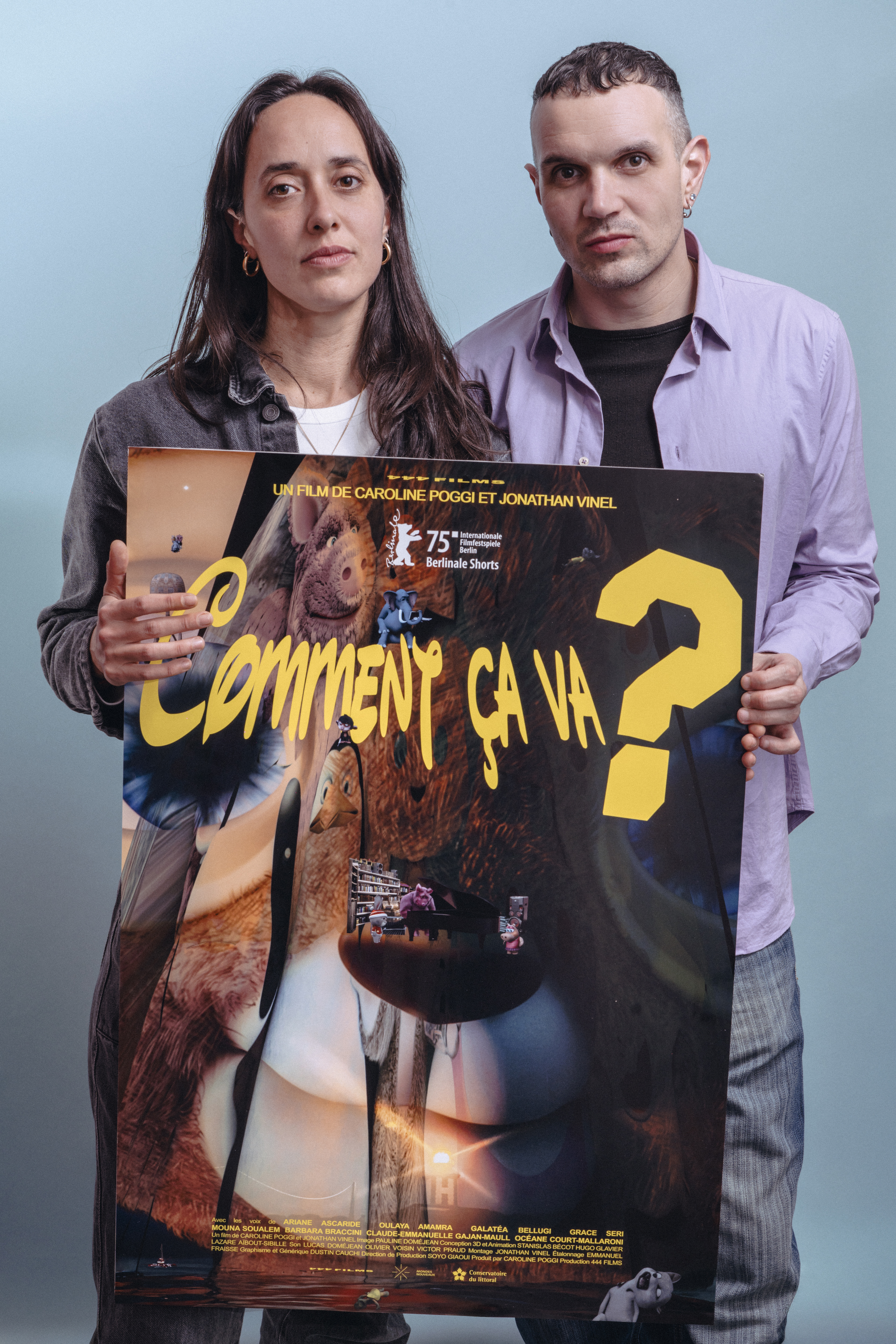
Born in Ajaccio, Corsica in 1990, Caroline Poggi studied at the Università di Corsica Pasquale Paoli and the Université Paris 8. She has made several short films with Jonathan Vinel; their work has frequently screened in Berlinale Shorts. Their film Tant qu’il nous reste des fusils à pompe (As Long as Shotguns Remain) won the Golden Bear for Best Short Film while their joint feature film debut Jessica Forever screened in Panorama and Eat the Night was selected for the Directors’ Fortnight at Cannes.
Born in Toulouse, France in 1988, he studied editing at La Fémis in Paris and has made a number of films with Caroline Poggi, with whom he was invited to Berlinale Shorts. Their film Tant qu’il nous reste des fusils à pompewon the Golden Bear for Best Short Film while their joint feature film debut Jessica Forever screened in the Panorama and Eat the Night was selected for the Directors’ Fortnight in Cannes.
In 2025, Caroline Poggi and Jonathan Vinel are returning to Berlinale Shorts with Comment ça va? while Tant qu’il nous reste des fusils à pompe (As Long as Shotguns Remain) can be seen as part of the jubilee programme “You and I Are Not Alone – Berlinale Shorts Revisited”.
What was your starting point for „Comment ça va“?
It was the end of the Covid, and a friend sent us a call for an artist grant. We wanted to continue our work with 3D characters. We shot and edited the film during the genocide in Gaza. The movie speaks to the horrors we saw, unfolding live, and the feeling of watching these atrocities. How to deal with our anger and desire for violence? All the characters have to deal with these extreme feelings.
This movie is special to us because it was shot in Corsica, where Caroline is born. We chose to shoot in Bonifacio, La Pointe de Pertusato and its lighthouse, in the most southern part of Corsica. We also chose the Gulf of Roccapina, with its famous Stone Lion overlooking the Mediterranean, for its magical and legendary side. It’s an incredible place that is unfortunately falling into ruin.
Being in these specific locations in Corsica, and more broadly in the Mediterranean, allowed us to envision a territory of transition, a place of arrival and departure. Our characters arrive by sea and leave by air, fleeing a violence that has taken root within them. They are looking for the keys to survival, seeking to relearn, understand and ultimately accept their anger and fears. Corsica has always been a political land.
Do you have a favorite moment in the film? Which one and why this one in particular?
We don’t have a favourite moment, it’s more the process and the journey that is our favourite moment. But it’s always emotional when you see the character for the first time. Here it was a bit long because it was animation, so the connection between the actress‘ voice and the body happened in post-production. The first character we saw was Lion, played by Galatea Bellugi. It was really exciting to see all the animals with the actress‘ voice. There is something magical and uncertain about this process.
What do you like about the short form?
It’s more instinctive because you can find solutions to do it quickly. You can test and try things without knowing if it will work or not. Features are more stressful because a lot of people are involved and it’s often more expensive. With our shorts, we keep exploring what we want to do. But, to be honest, we don’t feel there is a big difference when we are making features. We always try to have fun and experiment with the narratives.
*************************************************************************************
PRESS REVIEWS
„[Der Ton] changiert […] von unterhaltsam über philosophisch bis aktionistisch – das ist irgendwie auch die Tonalität des Films, der vielleicht auch ein bisschen vom Festhalten an den guten Ideen erzählen will, selbst wenn man im mentalen Katastrophenmodus versinken möchte.“
review by Marie Ketzscher for Berliner Filmfestivals
„Directorial duo Caroline Poggi and Jonathan Vinel return to the Berlinale for the fifth time with the animation How Are You? (France), in which Disney-like aesthetics meet a modern – and often nihilism-ravaged – musing on the world around us. A group of animals live on an island as they struggle to heal from the disease of modern life. This flits between the comedy, stark surrealism and fractured philosophy that have been the hallmark of Poggi and Vinel’s recent animations. There are moments that are laugh-out-loud funny – often helped by the juxtaposition of the cartoon-style CGI with the dark musings on mental and physical degradation – but the evisceration of current times makes the film a wallow in the viscera of contemporary society.“
review by Laurence Boyce for Cineuropa
„Jede*r Regisseur*in teilt mit ihren Filmen auch eine individuelle Sicht auf die Welt. Am explizitesten wird das in Comment ça va?. Der Film stammt von Caroline Poggi und Jonathan Vinel, welche in der Vergangenheit schon mehrfach bei den Berlinale Shorts vertreten waren und mit Tant qu’il nous reste des fusils à pompe sogar einen Goldenen Bären gewannen. In ihrem neuesten Film befindet sich eine Gruppe animierter Tiere auf einem leeren Küstenstrich und versucht, sich von den Übeln der Welt zu erholen.“
mention by Peter Bratenstein for zeitgeschichte online
„Comment ça va? (How Are You?) von Caroline Poggi, Jonathan Vinel wurde als Kandidat für den European Film Award ausgewählt. Hier sind die postmodernen Einflüsse am auffälligsten. Mit Comic-Tierfiguren, die einen rauen Küstenstreifen bewohnen, kreiert der Film eine Parabel auf die gegenwärtige Weltlage, auf gewaltsame Konflikte, Klimazerstörung, Flüchtlingshetze usw. und verknüpft sie mit existenzialistischen, postmodernen Dialogen und Kommentaren.“
mention by Isabel Roy & Verena Nees for World Socialist Web Site
„Das reicht von Animationsfilmen wie „Comment ca va?“, in dem eine Gruppe von Tieren versucht, Lösungen für die Probleme der Gegenwart zu finden…“
mention by Thomas Abeltshauser for Berliner Morgenpost (Paywall)
reactions on letterboxd
 Berlinale Shorts