
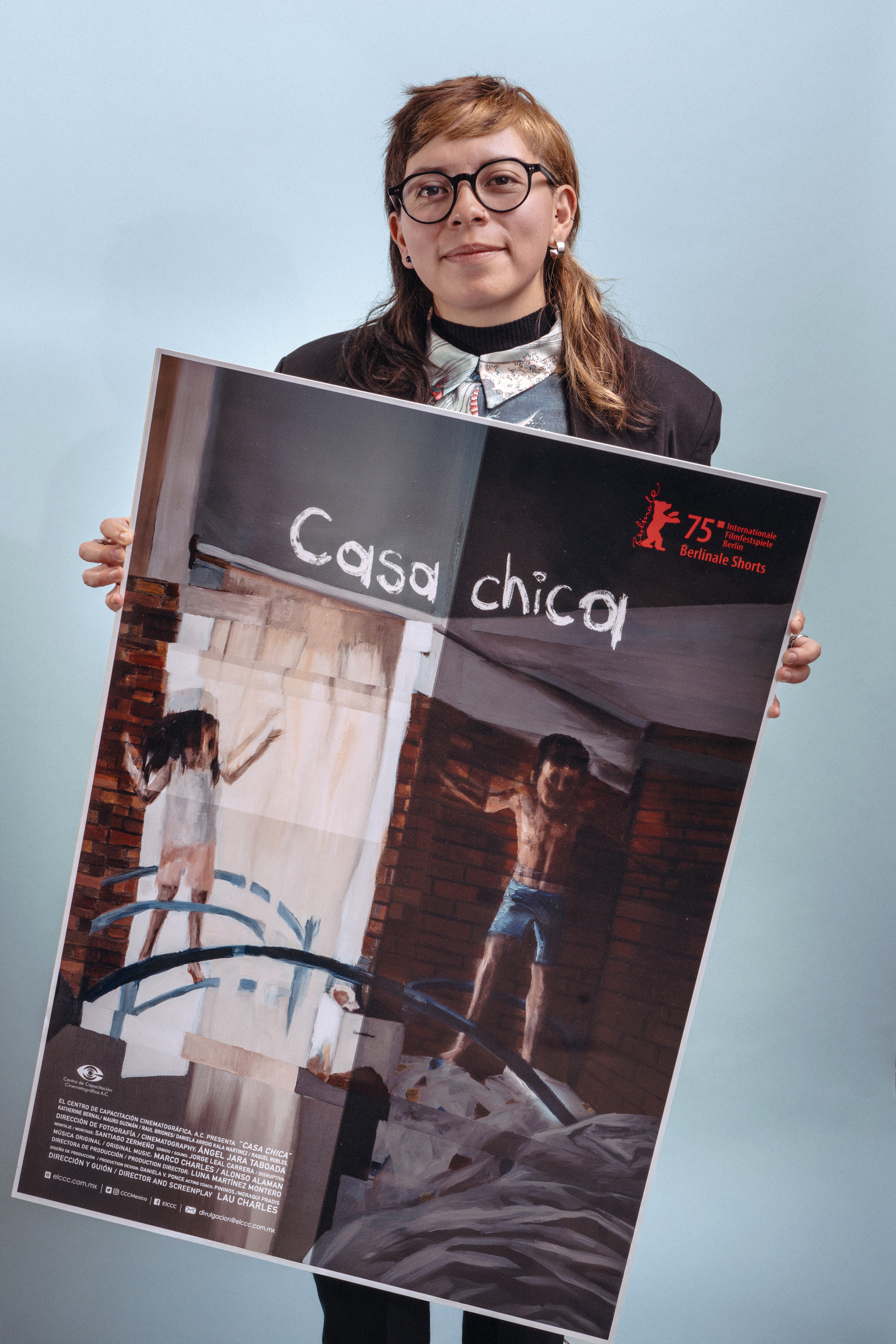
The director and visual artist Lau Charles was born in Mexico City in 1991. She studied film directing at the Centro de Capacitación Cinematográfica and visual arts at the Escuela Nacional de Pintura, Escultura y Grabado “La Esmeralda”. Her art and films focus on the world of childhood. She is co-founder of Pininos, a project that has been dedicated to casting and acting training for children since 2016. Her short film „Olote“ was invited to dozens of international festivals, including the Huesca International Film Festival.
What was your starting point for „Casa chica„?
The term casa chica (small house) refers to a form of concubinage in Mexican society, where some married men maintain a secondary family—a wife and children—separate from their primary family, known as the casa grande (big house). This is my story.
I always knew I had a half-sister, someone my age who almost shared my name. There was always a lingering sense that someone else like me existed—someone my father might kiss goodnight.
During the pandemic, I embarked on a journey of documentary and pictorial research. Through conversations with my mother and brother, I sought to reconstruct the fragmented memories of that parallel family that had occupied my thoughts for so long. As the world came to a standstill, a small camera became the perfect tool to peer into the past.
Each member of my family remembered the pain of that period in fundamentally different ways. I held onto the fragmented memories of a 6-year-old girl; my mother relived her experiences through the lens of a single mother’s struggles. But what struck me most was my brother’s story: an 11-year-old boy who became my guardian and protector, yet inevitably grew into a fragile and prematurely burdened adult.
Realizing that „our story“ was composed of such diverse perspectives became the backbone of „Casa Chica“. It is, at its core, a tribute to my most intimate accomplice: the boy who fought a thousand battles so I could keep playing — my big brother.
Do you have a favorite moment in the film? Which one and why this one in particular?
I don’t have a single favorite moment from the short, but what fills me with pride and deeply moves me is how, through the work and love of everyone involved, we were able to revisit and reconstruct memories in unique ways—manipulating time and perspective. I find it profoundly beautiful how a scene of a girl receiving her mother’s affection through a simple hairstyle can later transform into the scene of a boy watching his mother, trying to conceal her pain.
I especially appreciate how we managed to imbue spaces with symbolic meaning for the story. For example, the car becomes a key setting where Valentina’s universe and Quique’s universe coexist, visually and audibly distinct, yet inherently intertwined.
As I write, the image that most insists on being described is the final portrait of my real family. My brother, my mother, and I managed to create a space within cinema itself—one where we are curled up together, watching our favorite movie, and feeling strong, loved, and eternal.
What do you like about the short form?
I believe it is the boldest space in cinema. Short films often serve as the most immediate outlet for raw and radical ideas, both in form and content. While this can also happen in feature films, there’s something about the production model and the passionate drive of short filmmakers that makes these works exceptionally courageous and honest.
In the case of Casa Chica, it was wonderful to experiment with translating the concept of a pictorial diptych into cinematography, exploring freer approaches to staging, and building memories alongside the performers—all without the monumental and economically complex structure of a feature film.
I haven’t directed a feature film yet, but I hope to push experimentation to its ultimate limits in that format as well. Still, I will undoubtedly continue to explore short films as a complete and radical means of self-expression.
*************************************************************************************
INTERVIEWS
„En la escritura exploré la idea del díptico. Para mí hay dos ejes fundamentales: la edad de los personajes y el género: lo que se espera de la niña, distinto a lo que se esperaba del niño.“
Interview with Lau Charles for IMCINE
„Ce qui m’importait le plus, c’était d’essayer de capturer le fonctionnement de la mémoire. Mon frère et moi avons vécu les mêmes événements dans notre enfance, mais en raison de nos différences d’âge et de sexe, nos souvenirs sont distincts. Il était crucial pour moi de représenter cela dans tous les aspects du court métrage.“
Interview with Lau Charles for Le Polyester
PRESS REVIEWS
„Effortlessly naturalistic with two great child performances, Charles’ film expertly captures the heartache of growing up too fast and too soon.“
review by Redmond Bacon for Journey into Cinema
„In Casa Chica bricht die Welt der fünfjährigen Valentina zusammen, als diese merkt, dass sie nicht die einzige Tochter ihres Vaters ist. Der Film beleuchtet dabei eine in Mexiko geläufige Praxis des Konkubinats, bei der ein verheirateter Mann neben der Hauptfamilie („casa grande“ – großes Haus) eine Zweitfamilie unterhält. „This is my story“, schreibt die in Mexiko-Stadt geborene bildende Künstlerin und Regisseurin Lau Charles über den Film, der sich wie ihr Gesamtwerk ganz auf die Welt der Kindheit konzentriert.“
review by Peter Bratenstein for zeitgeschichte online
„Erwachsene streiten im Hintergrund oder deuten stellvertretend; den Kindern begegnen sie hingegen selten wirklich so fokussiert und auf Augenhöhe wie Lau Charles schnörkellos aufgewühlter Kurzfilm, welcher am Ende seiner ausschnitthaften Dichotomie einen Bogen in die Gegenwart schlägt und zu einem wirkungsvoll persönlichen Schlussbild findet.“
review by Paul Seidel for Riecks Filmkritiken
„Juste le quotidien d’enfants turbulents dans leur monde – Casa chica (présenté en compétition) nous immerge dans une réalité à hauteur d’enfants, mais le film ne se limite pas à cette formule parfois un peu creuse. En basculant audacieusement la narration entre la sœur et le frère, la Mexicaine Lau Charles enrichit avec intelligence les points de vue de l’enfance sur la famille et l’expérience de sa reconstitution. Un décor qu’on croit familier mais auquel Lau Charles apporte sa personnalité.“
review by Nicolas Bardot & Gregory Coutaut for Le Polyester
reactions on letterboxd
 Berlinale Shorts