
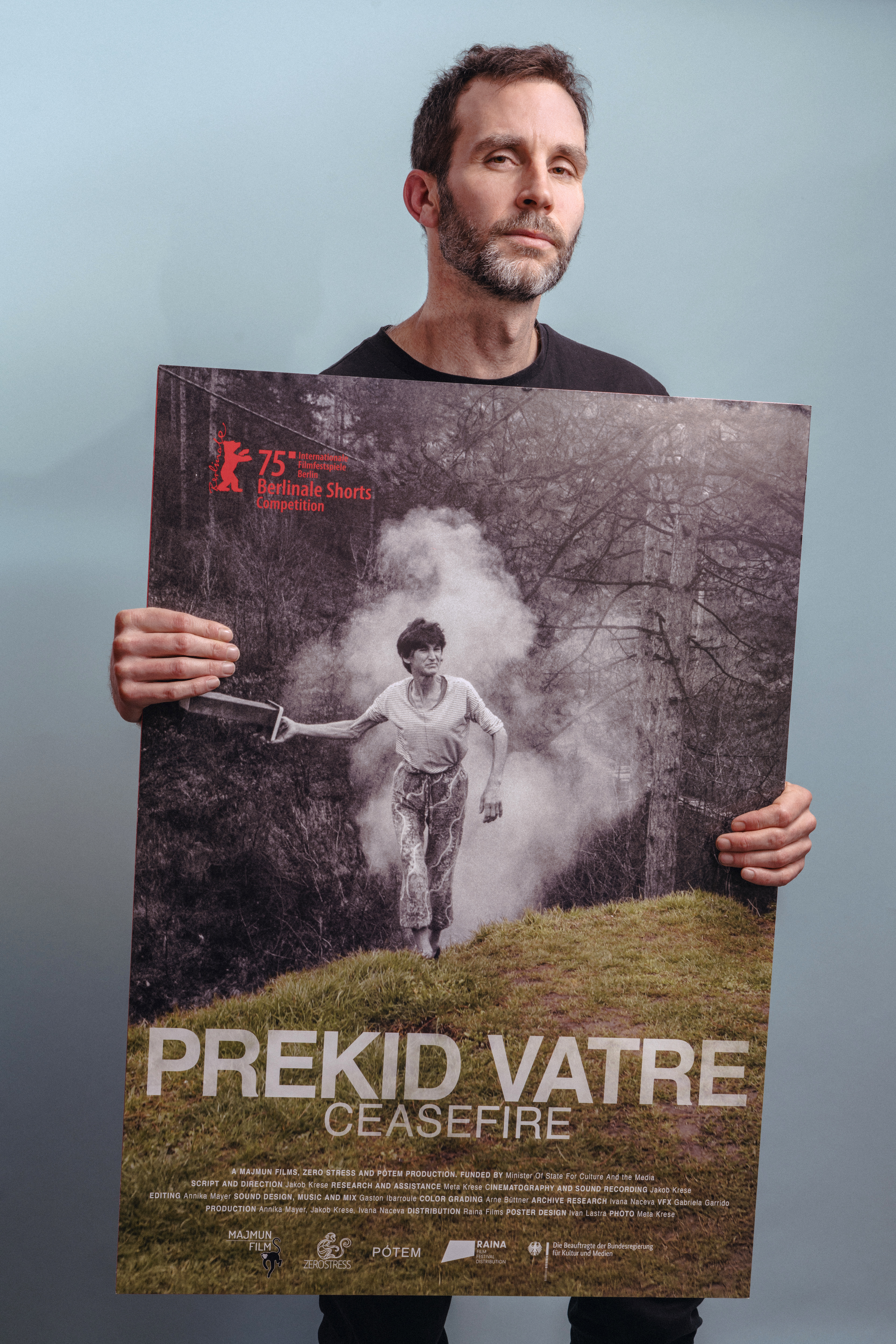
The filmmaker Jakob Krese grew up in former Yugoslavia and Germany. As the grandchild of Yugoslav partisans on one side and a Nazi judge on the other, he became obsessed with the tensions in the relationship between the individual and the collective and now explores these structural connections in his films, searching for past memories and future possibilities of resistance. He studied cinematography and directing in Berlin, Havana and Sarajevo and lives and works in Trieste, Ljubljana and Berlin.
What was your starting point for „Prekid vatre„?
At the beginning of 2015, my aunt Meta Krese and I went on a research trip along the so-called „Balkan route.“ At that time, there was little reporting on the route. Near Belgrade, we visited a reception camp for people fleeing their countries. While a social worker was showing us around the facility, which at the time primarily housed people from the Middle East, Meta pointed to a slightly distant barrack and asked, „What about that building?“
The social worker replied casually, „That’s where our people are.“
We didn’t understand and asked, „What do you mean by ‘our people’?“
„Oh, refugees still from our war,“ he said indifferently.
We couldn’t and didn’t want to believe that, 20 years after the war, people were still living in camps. And that we, coming from the same former country, knew nothing about it. It turned out there were still very, very many such cases.
Meta researched, wrote, and photographed on this topic for years, visiting nearly all the camps in Bosnia. She published articles, held exhibitions with her photographs, and shared stories about her travels and the people she met. She spoke with particular fascination about Hazira.
That’s how the idea for the film came about for the first time, leading soon to our first visit. Back then, I cautiously brought my camera along. Meta had built such a trusting relationship with Hazira over the years that, after just half an hour, I was asked by Hazira to start filming. That’s how the first ten minutes of the film came to be.
Do you have a favorite moment in the film? Which one and why this one in particular?
It is a tough question, but i think it is the first scene of the film showing Hazira weeding in the garden. This scene was filmed about half an hour after I met her. While weeding, she confided important parts of her life story to me—or perhaps more to the camera. She always connected her story to the weeds she was pulling out.
With the classic dark Bosnian humor that has fascinated me since childhood (during the war, our apartment in Berlin was a small welcoming center for people from Bosnia), she cursed the weeds, the war criminals Mladić und Karadžić, life itself, and her father, who had abused the entire family—all in the same breath.
It was during this first meeting that I became aware of her gift for synthesis. This ability to synthesize a difficult life story with dark humor always carries something warm and life-affirming. Since my childhood, I have admired this strength, this capacity to confront life’s harshness with humor while still holding warmth and hope within.
From the beginning, it was clear that this would be the opening scene of the film. Whether we succeeded in capturing the essence of this moment is something the audience will have to judge. It is definitely challenging to translate the full power of Bosnian humor. I just hope it isn’t lost in translation.
What do you like about the short form?
I believe it is the freest and most subversive film form I know. There are no tight corsets of narration, no prepackaged recipes for dramaturgy. It doesn’t fit into any categorization drawers. It has no time for trivialities but gets straight to the point, to the essence. It avoids unnecessary embellishments and small talk, like people who understand how precious and short life is.
It is a form in which we constantly reinvent ourselves. It demands to be playful while forcing us to remain consistent. This freedom to experiment combined with the necessity for rigor fascinates me.
I often feel compelled to advocate for it to have a place in arthouse cinemas—perhaps as an opening film, before a feature-length—so that it can be more seen and appreciated. At the same time, I admire the short form as one which has not yet integrated as yet another consumer good on the endless supermarket shelf, where it might lose its freedom and subversiveness.
*************************************************************************************
PRESS REVIEWS
„Though Krese has clearly fostered a certain intimacy with Hazira, he maintains a respectful distance, framing her with restraint and dignity. The numerous close-up shots, both indoors and outdoors, underscore the lingering sense of enclosure—between the survivors of Srebrenica and their descendants, still confined to the camp and its immediate surroundings, and the rest of Bosnian society.“
review by Aurelie Geron for Film Fest Report
„The film thrums with contemporary resonance, not only the war in Ukraine and the ongoing, never-ending situation in Gaza but also the relentless, terrifying Islamaphobia that exists all over Europe, most recently seen in the U.K. hate riots of 2024. Ceasefire shows us the chilling end result of such evil rhetoric.“
review by Redmond Bacon for Journey into Cinema
„Im Juli jährt sich das Massaker von Srebrenica und das Ende des Jugoslawischen Kriegs zum 30. Mal. Jakob Kreses Film ist eine berührende Hommage für all diejenigen, die noch heute unter den Folgen des Kriegs leiden und ein Versuch, die Geschichte Jugoslawiens und der 2,2 Millionen Geflüchteten stärker in das europäische Bewusstsein zu rücken.“
mention by Peter Bratenstein for zeitgeschichte online
„Kreses Dokumentarfilm zeigt das harte Leben Haziras und ihrer Familie im Flüchtlingslager Ježevac bei Tuzla. In ihr Heimatdorf in den Bergen über Srebrenica konnte sie nie zurückkehren. Es liegt heute in der Republika Srpska, dem abgespaltenen serbischen Teil von Bosnien und Herzegowina.“
mention by Isabel Roy & Verena Nees for Word Socialist Web Site
„The ebb and flow of war and peace is explored in the powerful doc Ceasefire by Jakob Krese (Germany/Italy/Slovenia), in which a survivor of Srebrenica tries to keep her trauma in check, even when her way of life becomes threatened […].“
mention by Laurence Boyce for Cineuropa
mention by ramp.space
reactions on letterboxd
 Berlinale Shorts