
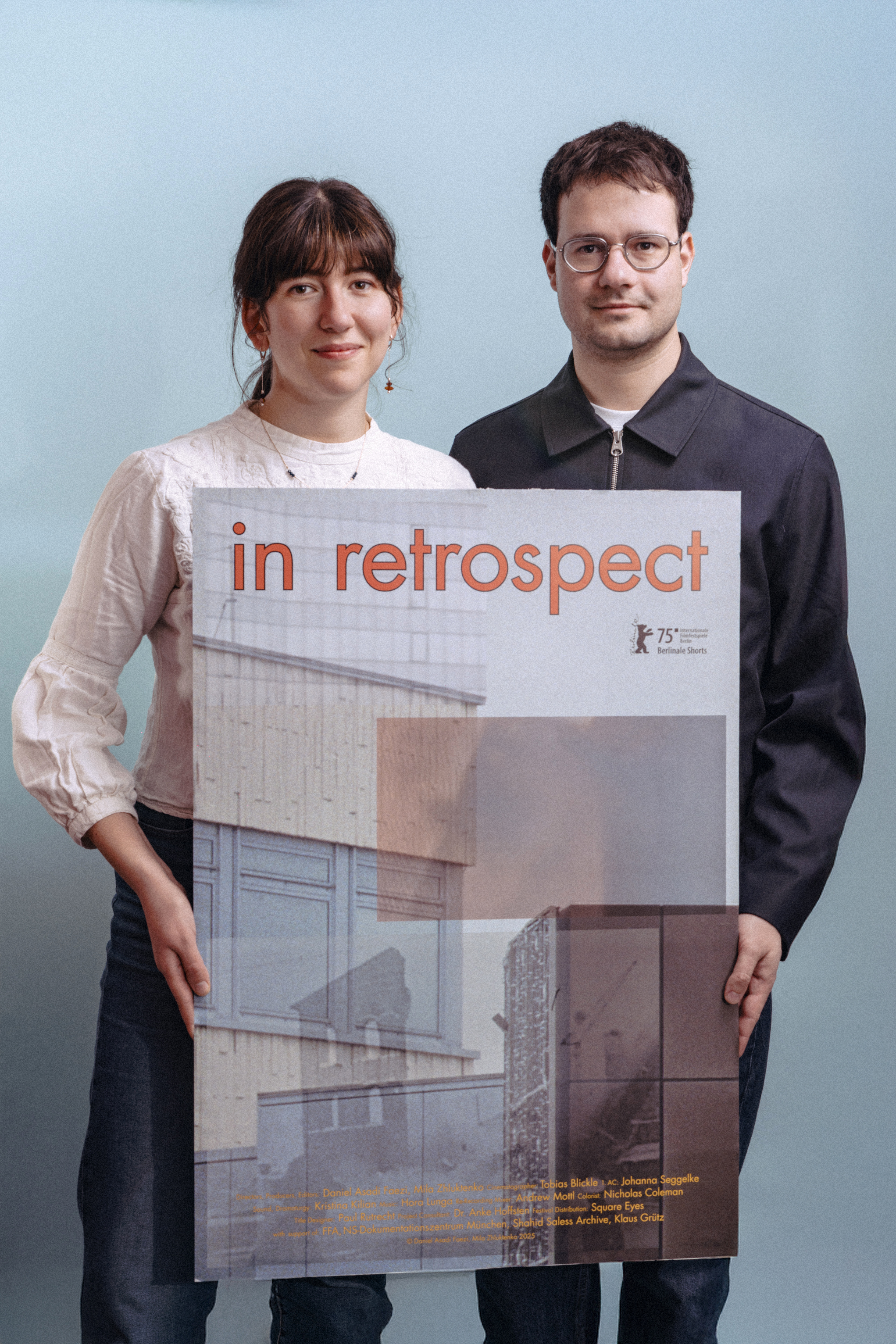
The director and producer Daniel Asadi Faezi studied documentary filmmaking at HFF Munich and at the National College of Arts in Lahore, Pakistan. He is a Berlinale Talents alumnus and his films have screened at numerous festivals including Locarno, DOK Leipzig and Ann Arbor in Michigan, USA. With Mila Zhluktenko, he has already co-directed „Aralkum“, which won Best Short Film at Visions du Réel, and „Waking Up in Silence“, which won the Special Prize of the International Jury for Best Short Film in the Generation Kplus section of the Berlinale.
Born in Kyiv, Ukraine, the filmmaker Mila Zhluktenko studied documentary at the Munich University of Television and Film (HFF). Her films have screened at several international festivals including the International Documentary Film Festival Amsterdam, the San Sebastián Film Festival, the MoMA Doc Fortnight and Visions du Réel in Nyon. „Opera Glasses“ won the Golden Dove at DOK Leipzig. „Rücblickend betrachtet“ is the third work she has co-directed with Daniel Asadi Faezi.
What was your starting point for „Rückblickend betrachtet„?
In 2023 we were commissioned by the NS-Dokumentationszentrum in Munich to work on a video installation that deals with different terrorist attacks that happened in Munich after the second world war. As we were going further into the research, we started to conduct camera tests at the different places where the attacks happened. The Olympia shopping mall was one of those sites. We started by capturing everyday life at the shopping mall on digital, then we wanted to try out working on negative and shot on 16mm and 35mm. During the testing we also went deeper into research of the history of the Olympia shopping mall itself. As filmmakers, living and working in Munich we know the place and we also were aware of the racist, right wing shooting that happened there in 2016. But when we started to dive into the history of the site, we felt that we saw new and important connections and an urge to make them visible through a shortfilm.
Do you have a favorite moment in the film? Which one and why this one in particular?
With the subject matter it is difficult to talk about a favorite moment. But the archival interview with the immigrant workers has a simplicity and sensitivity to it, that is touching, but at the same time very obviously demonstrating the impact of structural racism on the workers.
What do you like about the short form?
We really enjoy working with the short form, as it allows us to take risks and experiment. In a short film you can focus on a very small detail, strike a chord and let the vibration fade out afterwards. It is always a chance to find a new approach towards cinematic language. This is why watching shorts is also so exciting. You get a sense of a strong reduction, an essence, the result of a subjective exploration of something, but concentrated in just a few minutes.
****************************************************************
PRESS REVIEWS and INTERVIEWS
“There are things that we were seeing in Addressee Unknown that were painfully reminding us of what is happening now,” agrees co-director Zhluktenko, who goes on to stress the film’s jigsaw-type aesthetic. “It’s more an essayistic approach where we found many different things that speak to each other.”
interview by Nick Cunningham at Business Doc Europe
„Wir fingen den Ort zu verschiedenen Tages- und Jahreszeiten ein. Es entstand die Idee, die Bewegungen des Ortes in Mehrfachbelichtungen zu filmen. Dadurch entsteht der Eindruck von Gleichzeitigkeit. Menschen aus verschiedenen Zeiten, die sich an dem Ort treffen und überlagern. Die Gebäude sind zugleich klar umrissen und wirken wie stumme Zeugen. Diese Gleichzeitigkeit wollten wir auch in der Baugeschichte des Ortes erzählen. Da kamen die Archivaufnahmen ins Spiel. Sie zeigen verschiedene Dokumente und Aufnahmen aus der Nachkriegszeit, als der Bauschutt des Zweiten Weltkrieges an die Ränder Münchens gebracht wurde. Derselbe Schutt wurde dann zum Olympiaberg und zur hügeligen Olympialandschaft. Andere Archive zeigen die Erbauung des Olympia Einkaufszentrums und die migrantischen Arbeiter auf den Baustellen, die während des Wirtschaftsaufschwungs maßgeblich den Erfolg der deutschen Wirtschaft mitgeprägt haben.“
interview with Doreen Kaltenecker for Testkammer
„But this masterfully executed cinematic essay, by fixing its gaze on a single place and invoking its history, reminds us that certain truths remain inscribed in its very foundations: xenophobia and racism seem as immovable as the walls of Olympia.“
review by Aurelie Geron for Film Fest Report
„Less nihilistic, but just as uncompromising in its view of modern society, is Daniel Asadi Faezi and Mila Zhluktenko’s documentary In Retrospect (Germany). A shopping mall built by migrants for the 1972 Munich Olympics becomes the site of a racist shooting in 2016 as the film uses archive footage to muse on the connection between the present and the past. It is a powerful evocation of cycles of violence and hatred that much of society is unable to break.“
mention by Laurence Boyce for Cineuropa
„Faezi and Zhluktenko use a mixture of archival footage, current day images of the mall, simple text overlays and moody, experimental sound design to explore this shameful part of German history, twinning the 2016 shooting with the 1982 death of Semra Ertan, a 25-year-old Turkish migrant worker who set herself on fire in a Hamburg marketplace to protest the treatment of Turks in Germany.“
review by Redmond Bacon for Journey Into Cinema
„The German-Ukrainian collaboration Rückblickend Betrachtet (Looking Back), directed by Mila Zhluktenko and Daniel Asadi Faezi, is included in the Berlinale Short Films programme. It offers a thought-provoking exploration of hate crimes, drawing parallels between a hate crime during the 1972 Munich Olympics and a hate crime in 2016 at the same location. By recreating the 1983 film, it explores the invisible threads that connect the two events in time. „
mention by The New Voice of Ukraine
„Der Schweinfurter Filmemacher Daniel Asadi Faezi hat gemeinsam mit Mila Zhluktenko wieder einen neuen Kurzfilm gemacht. „Rückblickend Betrachtet“ feierte laut einer Mitteilung seine Uraufführung im Rahmen des Filmfestivals Berlinale in Berlin.“
mention by Main Post
„Mit der deutschen Geschichte, erzählt aus einer migrantischen Sicht, setzt sich der Film Rückblickend betrachtet von Daniel Asadi Faezi und Mila Zhluktenko auseinander. Das Olympia-Einkaufszentrum in München steht dabei im Fokus. Beim Bau 1970 waren zahlreiche Arbeitsmigrant*innen vor allem aus der Türkei, Jugoslawien und Italien beteiligt. 2016 fand am selben Ort ein rechtsterroristischer Anschlag statt. Neun Menschen verloren das Leben. Der Film sucht Kontinuitäten und Erklärungen in der Geschichte und gedenkt zugleich den Opfern rassistischer Gewalt in der Bundesrepublik.“
mention by Peter Bratenstein for zeitgeschichte online
„So spannen sie einen großen Bogen, der ein Gesamtbild entstehen lässt, bei dem Einwander:innen ein integraler Bestandteil sind und trotzdem angefeindet, ausgegrenzt und getötet werden. Diesen Themen spürte auch der iranische Filmemacher Sohrab Shahid Saless (1944-1998) in seinem Film „Empfänger unbekannt“ (1983) nach. Szenen aus diesem Film bauen die Filmemacher:innen ebenfalls in ihre Arbeit ein und liefern so einen vielschichtigen Kurzfilm, der die richtigen Fragen stellt und auch klar die Misstände und Untaten anprangert.“
review by Doreen Kaltenecker for Testkammer
reactions on letterboxd
 Berlinale Shorts