
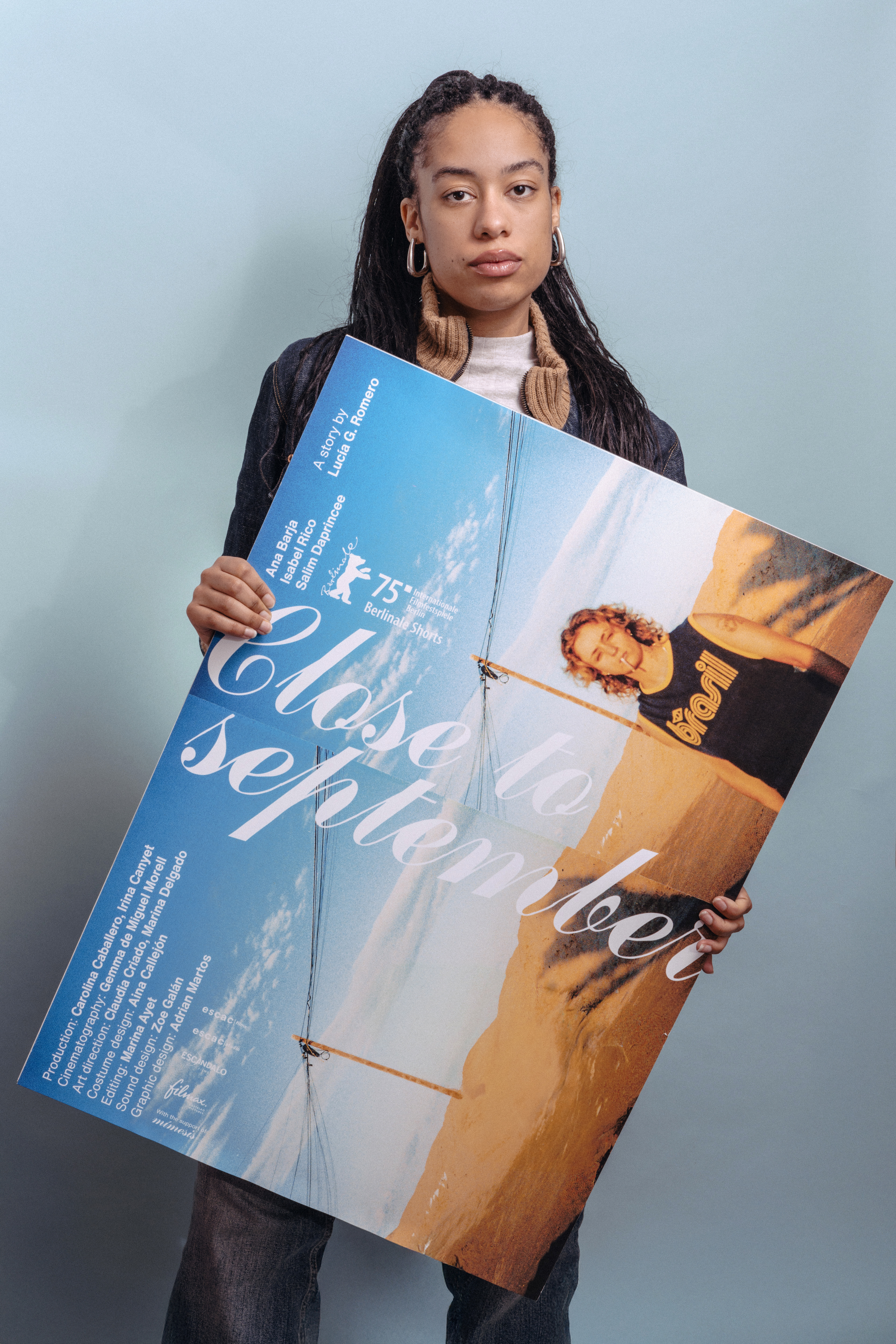
Lucía G. Romero was born in Barcelona, Spain in 1999. She received a full scholarship to attend the city’s ESCAC film school and graduated with a master’s degree in directing. Her graduation film Cura Sana was presented in the 2024 Generation section of the Berlinale where it won the Crystal Bear for Best Short Film. It also screened and won awards at numerous other festivals and was nominated for Best Short Film at the Catalan Film Academy Awards. The film is inspired by the director’s autobiography and Cuban roots. She is currently developing her debut feature film which explores similar themes.
What was your starting point for „Casi septiembre„?
I was interested in exploring fear of abandonment. I wanted to write about a character who had deep wounds in childhood due to neglect and since disconnecting from her attachment figures has a hard time being comfortable making connections with others. How is falling in love when no love has ever made you feel safe? How can you believe relationships can be lasting when you have had no evidence of that in your past? These are the types of questions I was wondering about myself when the character of Alejandra came to me. Then I build the world around her.
Do you have a favorite moment in the film? Which one and why this one in particular?
My favorite moment in the film is when Alejandra and her three sisters are watching a movie in front of their trailer. It’s almost nighttime and it’s so hot they have put their bed and their TV outside. Alejandra watches the lovers in the film with saddened eyes and slightly smiles, while her sisters make jokes about kissing and annoy her.
What do you like about the short form?
The short form it feels like a capsule that does not have to be anything else than what it is. Writing in short format forces you to encapsulate a story or a feeling in a few minutes and I find it often leads to every gesture of the film becoming important and intertwined with the others. While directing you can pay attention to detail. Every second counts.
*************************************************************************************
INTERVIEWS
„És lògic que es normalitzi l’ús de personatges racialitzats ara que la gent racialitzada estem explicant les nostres històries. Però és una mica trist que els directors blancs no s’adonin que al món no només hi ha gent blanca i que el ventall de representacions que tenim al cinema espanyol es limiti a la dona de fer feines.”
Interview with Lucía G. Romero for ara (Paywall)
„How can we navigate love when all we’ve known is chaos? What is stronger, love or fear? Those questions were on my mind way before starting to write about Alejandra, the girl who lives in a place where everything is temporary, and nobody ever stays.“
Interview with Lucía G. Romero for Testkammer
Die katalanische Regisseurin Lucia G. Romero, deren vorletzter Film „Cura sana“ 2024 mit dem Gläsernen Bären ausgezeichnet wurde, präsentiert uns jetzt „Fast September“, der dieses Jahr auf der Berlinale lief.
ARTE Kurzschluss – das Kurzfilm-Magazin | Interview mit Lucia G. Romero, Regisseurin von „Casi Septiembre“
4 Min. | Sendung vom 22/11/2025
Much like Cura Sana, Close to September also navigates themes of abandonment, along with the instinct to build walls so high that it becomes nearly impossible for anyone to break through them. When I ask what inspired her latest, Romero tells me she wanted to explore “what it’s like to live with a fear of abandonment, and what it’s like to desire a connection so much—but to be so afraid that you’re going to be hurt or abandoned again, that you just self-sabotage.”
Interview with Lucía G. Romero for Talking Shorts
PRESS REVIEWS
„Lucia G Romero returns to Berlin, after winning a Crystal Bear for her short Cura Sana in Generation in 2024 (see the interview), with Close to September (Spain), in which a girl living on a campsite finds herself developing a romance with a holidaymaker. With all of the urgency and humanity of her previous short, it’s a paean to growing up and – for once – the possibility of a brighter future.“
mention by Laurence Boyce for Cineuropa
„With just the short format, Romero gives us a sense of an entire world; cheap beer and discotheques, hotels with kitsch live entertainment, intense yet fleeting friendships, the desire to escape.“
review by Redmond Bacon for Journey into Cinema
„Nelson Yeo aus Singapur ergründet in Through Your Eyes wiederum die Erinnerungen und Sehnsüchte vierer Menschen und lässt diese miteinander verschmelzen, während in der queeren Liebesgeschichte Casi septiembre sich die Protagonistin Alejandra ihrer Angst stellt, verlassen zu werden. Die Shorts zeigen damit durch ihre Diversität und Bandbreite, was Kurzfilm kann und auszudrücken vermag.“
mention by Peter Bratenstein for zeitgeschichte online
„Déjà remarquée avec son très prometteur Cura sana (qui faisait partie de notre dossier sur les meilleurs courts de la Berlinale de l’an dernier), l’Espagnole Lucía G. Romero passe au niveau supérieur avec ce nouveau film présenté en compétition. On croit connaître ce décors d’amours de vacances, mais Lucía G. Romero déploie un sens du romanesque qu’on n’avait pas vu venir dans ce récit queer aux personnages puissants. Elégamment mis en scène, ce film au ton vif possède une écriture subtile qui laisse une place vibrante à l’irrésolu.“
review by Nicolas Bardot & Gregory Coutaut for Le Polyester
„A Casi septiembre, per exemple, el conflicte en la relació sexoafectiva de les protagonistes no sorgeix del fet que siguin dones o que una sigui racialitzada, sinó de la por a l’abandonament que sent l’altra. „
review by Xavi Serra for ara (Paywall)
„Close to September“ ist ein Kurzfilm von Lucía G. Romero, der von einer Liebesgeschichte genauso erzählt, wie von einem Leben an einem Urlaubsort und persönlichen Entwicklungen. Die Regisseurin Romero bündelt all diese Themen in einem leichtfüßigen Kurzfilm, der von dem Spielort, seinen Darstellerinnen und dem Gefühl des Sommers gleichermaßen lebt.
review by Doreen Kaltenecker for Testkammer
„[…] 20 Shorts in fünf Programmblöcken, die das Spektrum aktueller Themen und Ästhetiken abbilden. Das reicht von Animationsfilmen wie „Comment ca va?“, in dem eine Gruppe von Tieren versucht, Lösungen für die Probleme der Gegenwart zu finden, über den fiktionalen „Casi septiembre“, der von einer alles verändernden Sommerliebe auf einem Campingplatz erzählt, bis zum iranischen Dokumentarfilm „Dar band“, in dem sich Menschen mithilfe moderner Technologien gegen Überwachung und Unterdrückung zur Wehr setzen.“
mention by Thomas Abeltshauer for Berliner Morgenpost
mention by ramp.space
reactions on letterboxd
 Berlinale Shorts