
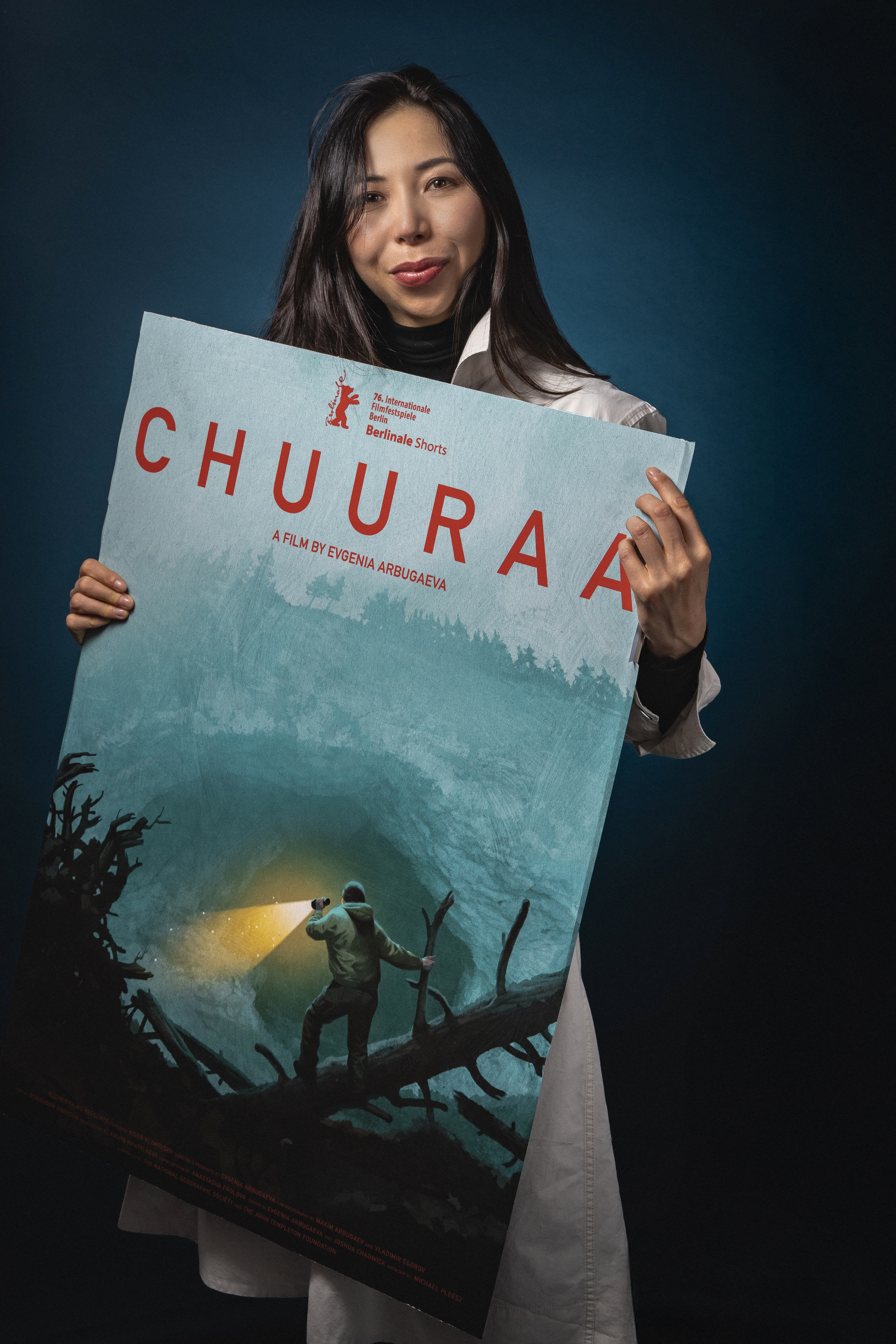
Born in Tiksi on the coast of the Laptev Sea in the Russian Arctic in 1985, the filmmaker and photographer Evgenia Arbugaeva now lives in the UK but remains connected to her homeland and covers stories on climate change and Indigenous communities. She is a National Geographic Explorer and a recipient of the ICP Infinity Award and the Leica Oskar Barnack Award. Her short film Haulout, which she directed with her brother Maxim Arbugaev, premiered in the 2022 Berlinale Shorts and was nominated for an Oscar. Chuuraa is her second film.
What was your starting point for „Chuuraa“?
I am from the Republic of Sakha Yakutia in Eastern Siberia. And even though I am now based in London, I am connected to my homeland and the way Sakha people sense the natural world and honor its spirits. Most of the Arctic region is underlain by permafrost – a “permanently” frozen ground. But as climate warming accelerates, permafrost thaws and releases greenhouse gases and resurfaces ancient animals, microorganisms and with them, potentially harmful viruses. For years I’ve been thinking how to tell the story of this pressing ecological issue through the lens of indigenous people who grapple with it firsthand.
I met the paleontologist Aisen Klimovskii who does fascinating work – he descends into the caves deep within the permafrost in search of prehistoric animals, in particular Pleistocene predators that have been preserved in frozen soil for 40,000 and more years. He told me that once he lost his torch in the cave, he was wandering in the pitch darkness for hours looking for the way out. He thought that he may not survive. At some point he started to hear voices and experience hallucinations. The thoughts of the taboos warning against disturbing spirits of dead creatures lingered in his head. The emotion of this story served as a basis for the film.
In our culture myths and reality often co-exist. The traditional epic poetic storytelling is still a living art form and it inspired the narration of the film.
Our film is a blend of Sakha folklore, contemporary science and personal experience of Aisen.
Do you have a favorite moment in the film? Which one and why this one in particular?
When Aisen exits the cave at the end of the film. That’s when we finished shooting in this extremely dangerous cave. I was worried for the safety of my brave crew every day we were there. So I finally exhaled. But also because my brother, cinematographer Maxim Arbugaev, created a truly beautiful shot of this moment.
What do you like about the short form?
Short form was the best possible form for our story – a poem, perfectly structured, but leaves a lot untold.
*************************************************************************************
PRESS / REVIEWS / INTERVIEWS
„Nommée aux Oscar pour son précédent court documentaire Haulout (déjà sélectionné à la Berlinale), Evgenia Arbugaeva donne à voir des paysages uniques. Dans un coin de forêt du cercle arctique, une grotte est littéralement en train de fondre, prête à révéler ses secrets prisonniers de la glace.“
review in Le Polyester
 Berlinale Shorts