
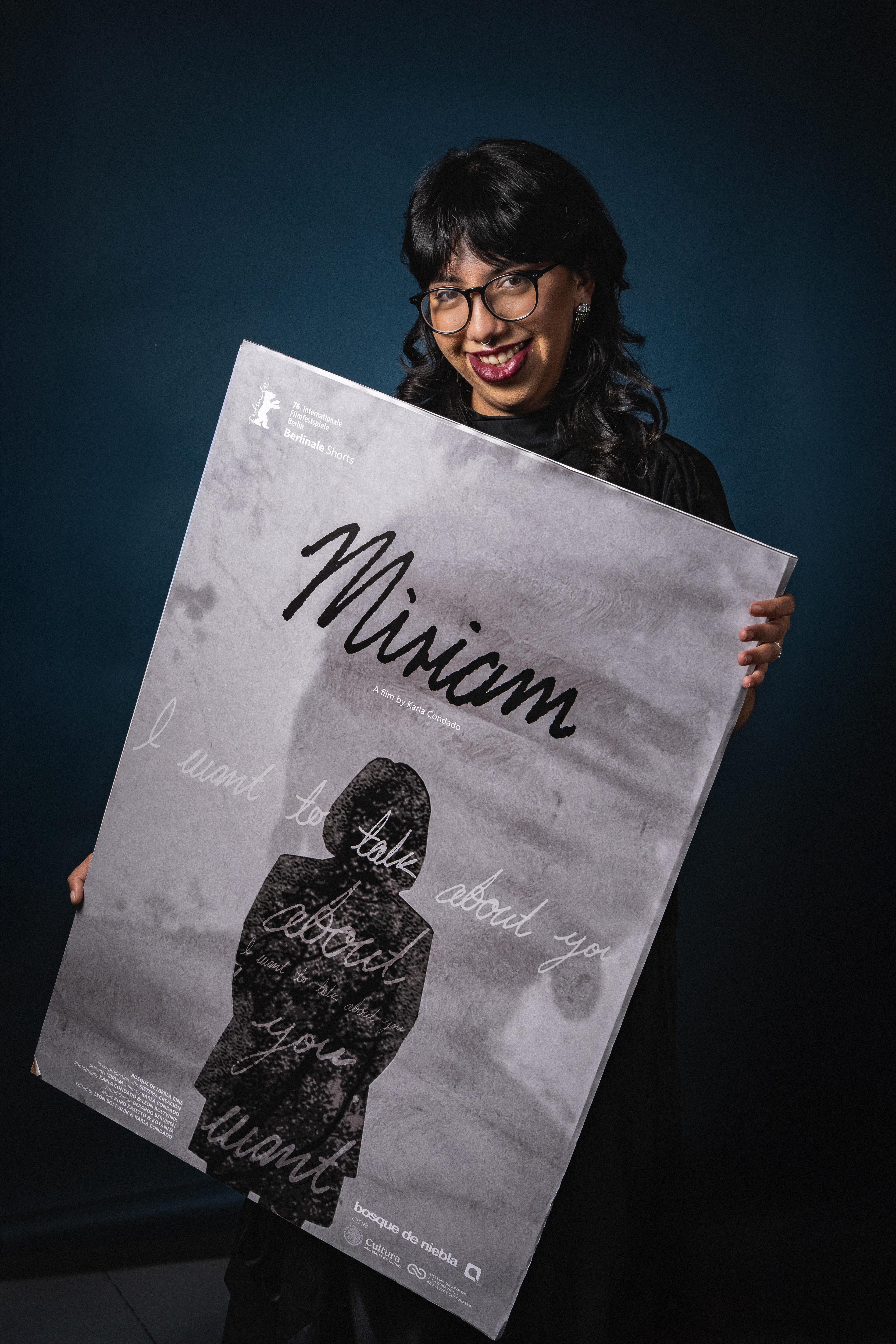
The director and cinematographer Karla Condado was born in Puebla, Mexico in 1999 and studied film at the Escuela Superior de Cine in Mexico City. In 2024, the short film Yaxche’oob, for which she was director of photography, was nominated for an Ariel for Best Documentary Short by the Mexican Academy of Film Arts and Sciences. She received a grant from the Programa de Estímulo a la Creación y Desarrollo Artístico (PECDA – Jóvenes Creadores) for her directorial debut, Miriam. She is a founding partner of the Bosque de Niebla Cine production company.
What was your starting point for „Miriam“?
When I was growing up, I realized that I had an irrational fear of romantic relationships, and I didn’t know why. Later on, I understood that I associated love with violence, with the fear that my partner might hurt me, that they might kill me, like my aunt was killed. I then began trying to talk about this with my family: to talk about my aunt, about femicide; but I was met with avoidance and silence. Meanwhile, the pain and fear kept
building inside me, because I wanted to fall in love, I wanted to trust.
That was when I started asking myself what was really happening. I realized that I had never allowed myself to truly understand femicide, grief, absence, and what it meant to grow up as the only girl in my family. Through cinema, I found a way to explore what I was feeling, how I felt, what hurt me, what made me angry. Of course, it was through a therapeutic process that I was able to begin developing this film.
Little by little, I was able to talk to my family, first they didn’t know what my film was about; I was afraid to tell them, – how do you even bring something like this into a conversation?- Eventually, I showed them the film, they were able to see how I felt; and that was the most important thing for me: to talk about this with them. This film is for my family, and for my aunt, who is no longer here.
Do you have a favorite moment in the film? Which one and why this one in particular?
When I was able to talk to my father about my aunt and what we had all been feeling over the years, and we were honest with each other, him as a father, and me as a daughter. I went into that encounter without a camera, without a sound recorder; I hadn’t planned anything. It was something completely outside the film, and that’s what I love most. My film became the perfect excuse to talk about something I had never dared to discuss with my family, and it was the most beautiful experience I’ve ever shared with my father.
What do you like about the short form?
That it allows me to express myself in a clearer, more condensed way. It forces me to have solid ideas without getting lost or stretching them out over time. I believe every story has its own rhythm, but with my first short film, I felt very comfortable with the form.
*************************************************************************************
PRESS / REVIEWS / INTERVIEWS
„Para mí el cine siempre ha sido entre un juego y algo muy serio. Me encanta estar filmando porque me divierto muchísimo, pero también lo veo como una herramienta de denuncia”, a esta casa editorial además de que agrega: “El cine permite llegar a muchísimas audiencias y hablar de temas que normalmente no se quieren nombrar.“
article and interview in El Sol de Puebla
„Entre los seleccionados se encuentra Miriam de la directora de fotografía, directora y productora mexicana Karla Condado. El cortometraje funge como una carta cinematográfica de la directora a su tía, quien años atrás fue víctima de feminicidio por parte de su pareja.“
article in Hollywood Reporter en Español
„Au début c’était difficile, parce que nous avons essayé juste le texte écrit, puis juste la version avec voix-off. Mais pour moi, ce n’était pas suffisant, alors nous avons pensé que nous pourrions les mélanger, mais nous devions trouver un rythme, ça ne pouvait pas être juste les deux langages en même temps.“
interview in Le Polyester
„Condado nähert sich der Verbalisierung des Traumas auf doppelte Weise, in Schrift und Wort: Per Voiceover ordnet sie brüchige Erinnerungen an ihre Tante; emotional gefärbt ist die Stimme, die manchmal wegbricht, ob der Angst und der Ohnmacht. „
review in critic.de
„“Miriam” se basa en la experiencia de vida que le dejó el feminicidio de su tía a manos de su pareja, donde repasa sentimientos como el dolor, el miedo y el proceso que han llevado a cabo para asimilar el hecho a casi 14 años.“
article in Puebla online
„Other Mexican works included the youth-focused short “When I Get Home” and the short documentary “Miriam,” as well as nine Mexican filmmakers who were selected for the Berlinale Talents training program.“
mention in Mexico News Daily
„Miriam est un film intime mais qui traite plus largement des féminicides, où les mots pudiques inscrits à l’écran prennent le relais quand la voix vacille. Tandis que sa mémoire pâlit, la réalisatrice brise le silence dans cet exercice cathartique à la mise en scène poétique.“
review in Le Polyester
 Berlinale Shorts