
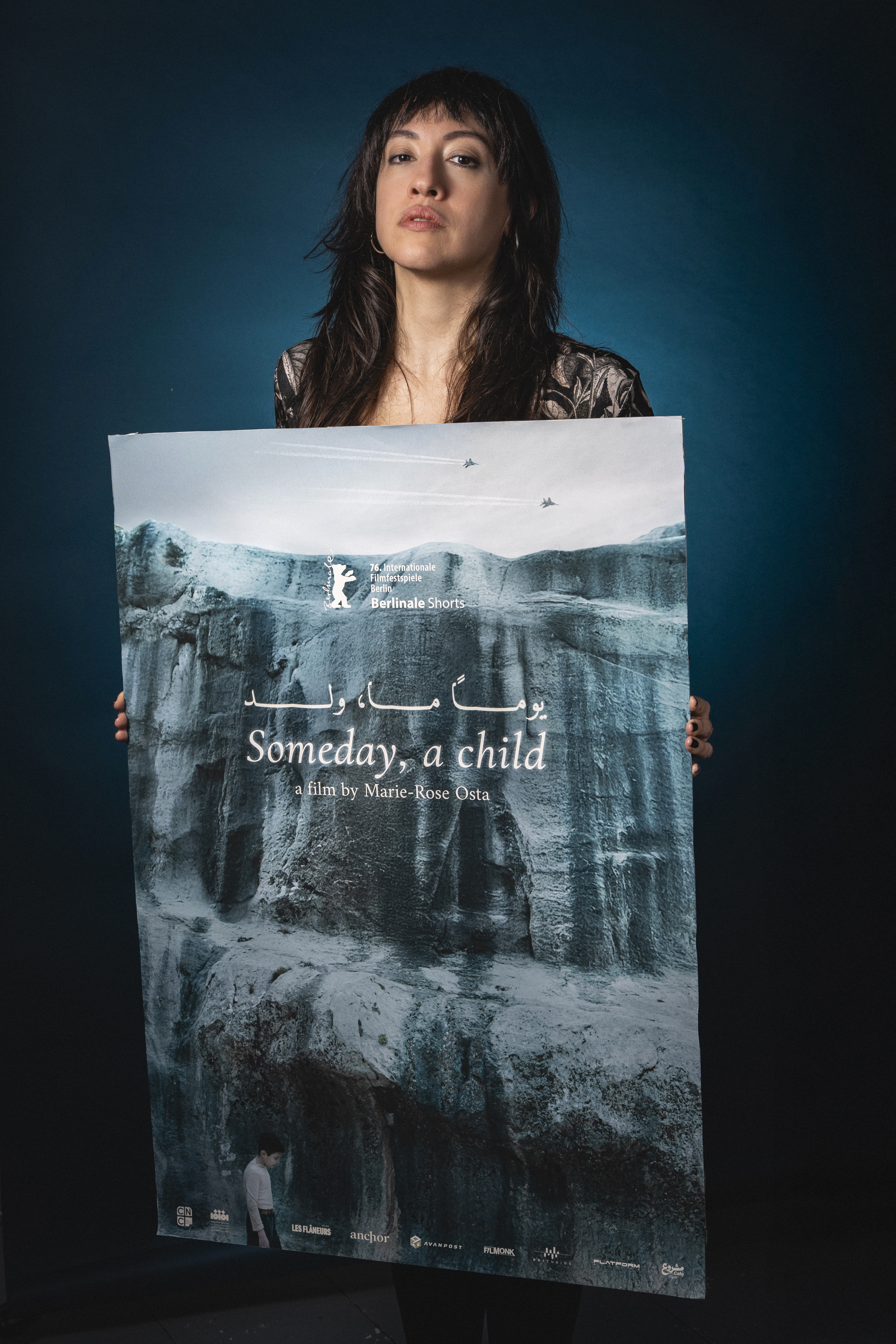
The Lebanese filmmaker and screenwriter Marie-Rose Osta has a master’s degree in filmmaking from the Académie Libanaise des Beaux-Arts in Beirut. Her short film Then Came Dark won a Special Jury Prize at the Cairo International Film Festival and was selected for the Biennial Sesc_Videobrasil. She is co-founder of Les Flâneurs Films, a production studio located in Paris.
What was your starting point for „Yawman ma walad“?
In July 2006, I was a teenager in Beirut, lying bored on my bed, not following politics, not understanding what was about to happen. I heard a warplane overhead, rare enough at the time to make me pause. A strange unease rose in me, as if something was coming. Almost without thinking, I said out loud, “Boom.” A second later, an explosion hit nearby.
For a brief, terrifying moment, it felt as if my voice had summoned it, before I went outside, heard the news, and understood that this was the beginning of the 2006 Israeli attack on Lebanon.
That instant, when sound turned into impact and instinct turned into reality, never left me.
Yawman ma Walad grew from that sharp emotional imprint, and from a belief I’ve always carried: that we are born with an instinctive power inside us, something raw and untamed, and that growing up often means being taught to suppress it. Children don’t yet know how to contain what moves through them. They react instinctively, emotionally, without strategy or ideology.
The child in the film doesn’t understand war or enemies. The planes are not political symbols to him; they are a disturbance. They invade his sleep, his body, his space. And like a child, he reacts. Not as an act of war, but as an act of nature responding to intrusion.
The political layer exists because the child exists in a real place. But the film begins somewhere more fragile and more dangerous: a child’s inner power colliding with a world that is afraid of it.
Underneath, I allow myself one thought: that the power we are born with could push back against domination by refusing to be shaped by fear.
Do you have a favorite moment in the film? Which one and why this one in particular?
My favorite moment is the egg scene. It’s a silent one-on-one between the uncle and the boy. The uncle boils two eggs in the same pot, at the same time. The boy chooses one egg and the uncle takes the other. Then they play a simple egg-cracking game, tapping the tips of the eggs against each other to see which one breaks first and loses. From the first tap, the boy’s egg cracks. It’s raw.
That’s what makes the moment disturbing and moving for me: it shouldn’t be possible. It’s as if something in him refuses to set, to become solid, to behave the way it’s supposed to. The uncle takes the broken egg from his hands and throws it away, while the boy stays still, looking at his hands as if they were guilty, thinking, “Look what my hands did.” It feels like a quiet confession of the boy’s inner world. And because nobody speaks in this scene, viewers come to me with completely different interpretations, which I love.
What do you like about the short form?
Writing my debut feature helped me find my answer to this question. I understood that form goes
hand in hand with the kind of impulse that initiates a project.
I’ve worked with the short form for a long time, from very short pieces to essays and more
experimental work. Over time, I’ve realized that for me a short film begins with a single element
that grips me. Sometimes it’s a location I want to inhabit. Sometimes it’s an emotion that feels
vivid and unresolved. With this short film, it was both: a place and an emotional state. I focused
on those two things, and the narrative emerged later.
With the feature, I’m not starting from a single moment, but from a longer state, a deeper layer of
memory. The question is larger, and it demands more time, rumination, transformation, and
accumulation. The form is already inside the starting point. For me, it is the duration that reveals
itself as a response to the main question.
I can now clearly say that what I love about the short form is its intensity. It lets me stay with one
tension, one space, one feeling, and push it until it reveals something. It lets that exist fully, until
my obsession is satisfied, absorbed, soothed, consumed, and finally put to rest. For me, a short is
a focused obsession.
*************************************************************************************
PRESS / REVIEWS / INTERVIEWS
„Yawman ma walad (Someday a Child) unfolds as a delicate allegory of inheritance and restraint, where the violence of the outside world echoes in the intimate act of self-erasure. Osta’s film quietly asks what it costs to survive by hiding who you are, exploring the tension between potential and the pressures of conformity, and revealing how childhood and power intersect in moments of both awe and fear.“
review in Curation Hour
„Written, directed, and produced — including editing and casting — by the 38-year-old filmmaker, this 27-minute short film (which received funding from AFAC) paints the portrait of a child with extraordinary powers, in what resembles a contemporary fable revisiting the myth of David and Goliath.“
review and interview in L’Orient Today (available for subscribers)
„Lauréate de l’Ours d’or, cette fable à la mise en scène inspirée traite de la brutalité de la guerre qui envahit le monde de l’enfance.“
review in Le Polyester
 Berlinale Shorts