
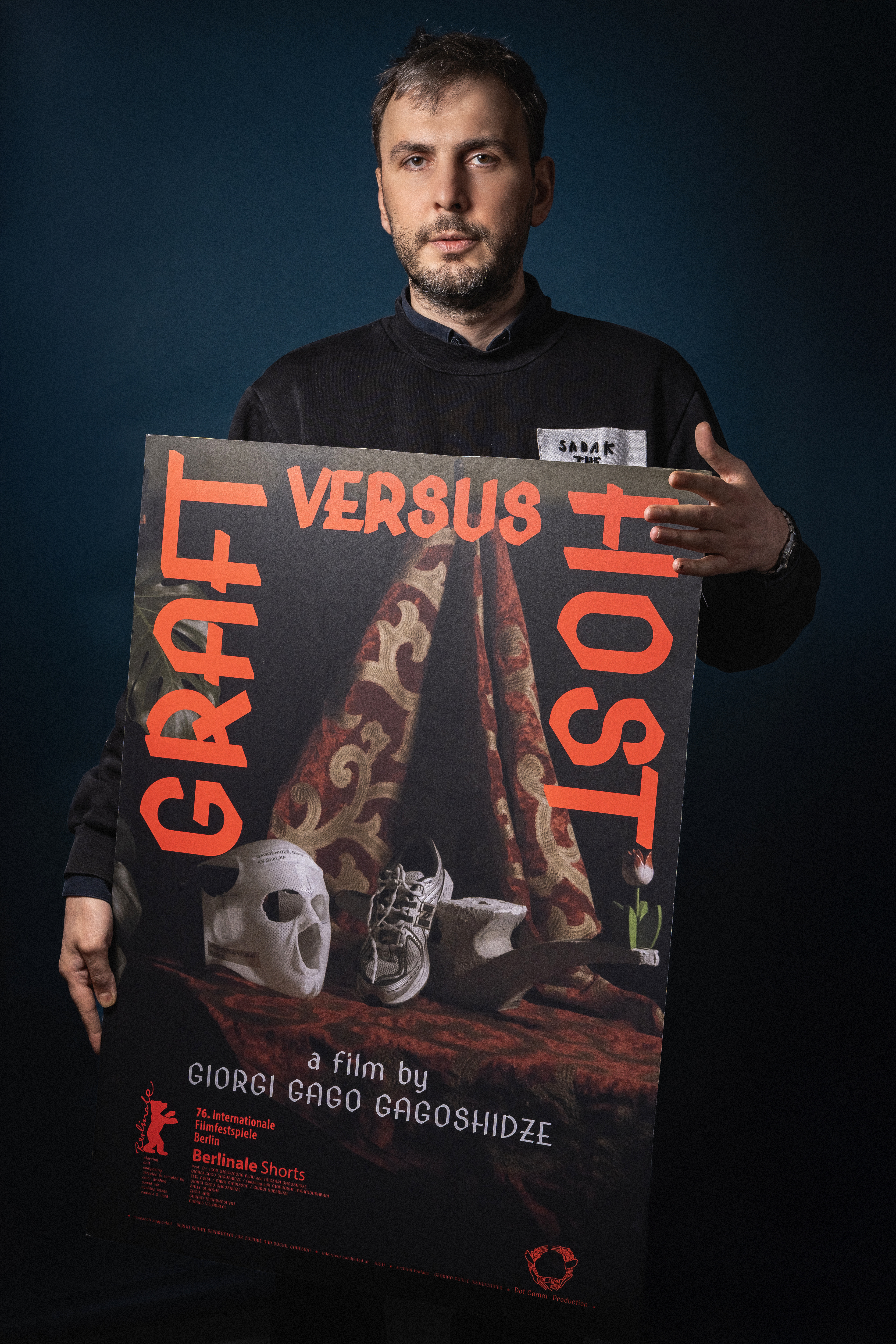
Born in Kutaisi, Georgia in 1983, the artist and filmmaker Giorgi Gago Gagoshidze is now based in Berlin. He studied at the State Academy of Fine Arts in Tbilisi and then took a degree in new media at the Berlin University of the Arts. His works focus on the moving image, the political background of its production and distribution, and its socio-political significance. They have been presented in numerous international contexts including at the Taipei Biennial in 2023, the National Art Center in Tokyo and the SculptureCenter in New York.
What was your starting point for „Graft Versus Host“?
In 2022, I was researching an economic experiment in agriculture in a small Soviet Georgian village, Abasha. The experiment took place in 1974, and it was one of the many attempts seeking possibilities to pull the Soviet post-war economy out of a severe crisis. It was a global crisis, so on the other side of the “Iron Curtain,” the capitalist world was also looking for ways to get rid of the economic crisis.
Apparently, both sides started borrowing elements from their rivals’ economies. The United States started investing state capital in Silicon Valley, while the Soviets started stimulating labour by introducing a limited form of ownership.
These experiments created fertile ground for the rise of a local economic elite, who eventually turned their economic capital into political power, influencing global politics to this day. One we know as oligarchs, and the others, tech entrepreneurs.
I had some kind of conceptual framework for the film, but I missed something that could break the didactic documentary approach. In September of the same year, I was diagnosed with cancer, and I fully dropped the film production to focus entirely on treatment. When I eventually returned to work, this experience became the backbone of the film, providing a speculative language through which to reflect on recent historical and political events that I had been researching before.
Do you have a favorite moment in the film? Which one and why this one in particular?
Being aware of the risks of how biology can be misused as a metaphor for naturalising society’s order, it is still fascinating to observe how the film attempts to bring medical and biological language into dialogue with the socio-political realm, and how often this attempt fails drastically.
Yet the film remains stubborn and celebrates the rare moments when these languages briefly synchronize and begin to be complementary to one another. Such a moment occurs when Prof. Dr. med. Igor Wolfgang Blau, through jump cuts, is juxtaposed with Anatoly Chubais. There, the two languages are synchronized to articulate the historic moment of dismantling communist ideology in order to create a platform for new political and economic forms of governance in the post-Soviet context.
What do you like about the short form?
As an artist/filmmaker, in my practice I am trained to manoeuvre within this limited length, since this duration already reaches the time scope of what is typical within an art context. Also, it is cheaper. It is a format that allows me to produce fairly independently. This is what my computer CPU can reliably handle, giving me security for not being dependent on unreliable funding infrastructures.
*************************************************************************************
PRESS / REVIEWS / INTERVIEWS
„Just 31 minutes long, [the film] is nonetheless packed with ideas, juggling archive footage, personal reflections and DIY computer graphics in a style reminiscent of English documentarian Adam Curtis or German video essayist Hito Steyerl, under whom Gagoshidze studied at the Berlin University of the Arts.“
article and interview in the Guardian
„In seinem spekulativen Videoessay verzahnt der Filmemacher Giorgi Gago Gagoshidze seine eigene Krankengeschichte mit den geopolitischen Veränderungen nach dem Kalten Krieg und ihren Auswirkungen auf die heutige Politik.“
mention by Kunsthochschule Kassel
„Não é descabido dizer que os grandes festivais internacionais privilegiam propostas marcadas pela inovação e pela experimentação, sobretudo nas secções de curta-metragem, tradicionalmente mais abertas à emergência de novas linguagens.“
article in Krino
 Berlinale Shorts