
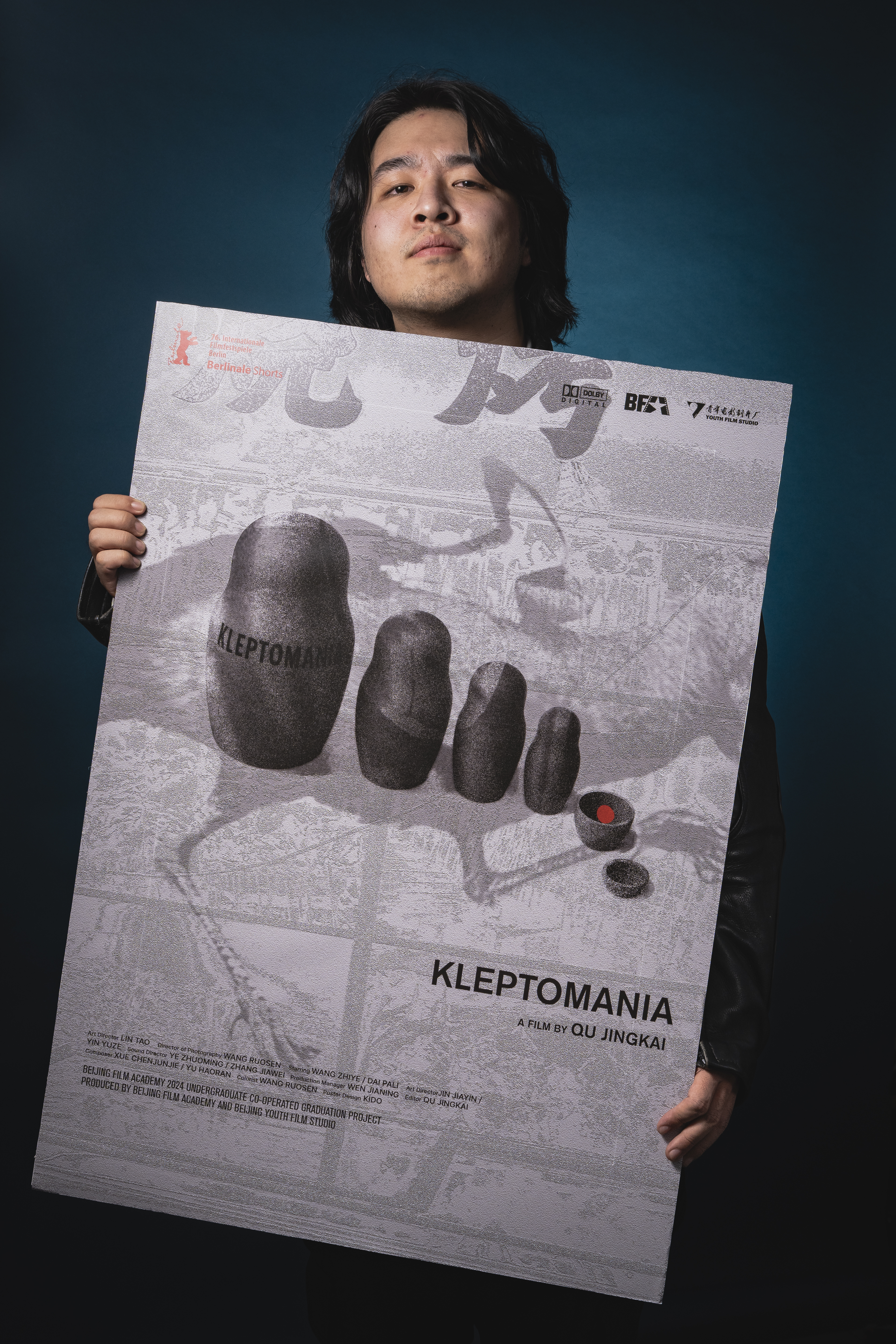
Born in Inner Mongolia in 2000, Jingkai Qu is a graduate of the Beijing Film Academy. Driven by a curiosity about the world, he weaves his travel experiences into his filmmaking. He is currently working on an experimental documentary tracing the mysteries of shamanism in South America, while also developing a feature-length narrative inspired by the raw, intimate textures of real-life love.
What was your starting point for „Di san xian“?
Sometimes people are unaware of how they have become who they are. It may be something as small as a childhood incident that quietly alters the trajectory of one’s life. And when an act of real violence enters a child’s world, one can’t help but wonder how such an experience seeps into their inner landscape and reshapes them over time. How does violence take root, and what kind of person might it ultimately produce? These were the questions that first compelled me to begin this project.
Do you have a favorite moment in the film? Which one and why this one in particular?
One moment in particular stands out for me: the scene in which a bag of sheep entrails is thrown onto a taxi. I feel this moment encapsulates the entire tone and spirit of the film. The violence occurs on a cold, deserted street; inside the car, a storytelling radio program recounts an ancient tale, while the startled driver shouts into the emptiness around him. Each character, in their own way, directs violence toward an absent or abstract other, while simultaneously remaining powerless in the face of the violence inflicted upon them.
What do you like about the short form?
I see the short film form as an art of “less is more,” one that offers a particular kind of freedom. When making short films, I approach the process experimentally. Cinema has reached a point where no single element can be considered indispensable—not even narrative itself. This freedom allows me to explore the form’s limits, to work with absence as much as presence. It is precisely this openness, this space for exploration, that makes working in the short format so liberating for me.
*************************************************************************************
PRESS / REVIEWS / INTERVIEWS
„Eine Welt, die nicht nur von häuslicher, sondern von vieler Art Gewalt geprägt ist, welche ihren Weg immer wieder in die ruhigen, kühlen Aufnahmen findet. Sei es in beiläufigen Gesprächen, in Videospielen, in Form abgekauter Hähnchenknochen, riesiger Tiergerippe, Schlägen auf die Handfläche. Oder in Form fehlender Wärme, fehlender Zuneigung. Jingkai Qus kühle zwanzig Minuten suchen keine analytischen Erklärungen, sondern in ihrer Stille und Zurückhaltung unheimlich aufgewühlte Gesellschafts- und Figurenskizzen. Und das auf einnehmende, fein konstruierte Art und Weise.“
Review by Riecks Filmkritiken
„Jingkai Qu fait le récit initiatique d’un jeune garçon qui, inspiré par les dinosaures, les oiseaux et surtout les adultes autour de lui, apprend la violence qui régit les rapports à autrui. Une narration elliptique rehaussée par un point de vue formel très prometteur.“
review in Le Polyester
 Berlinale Shorts