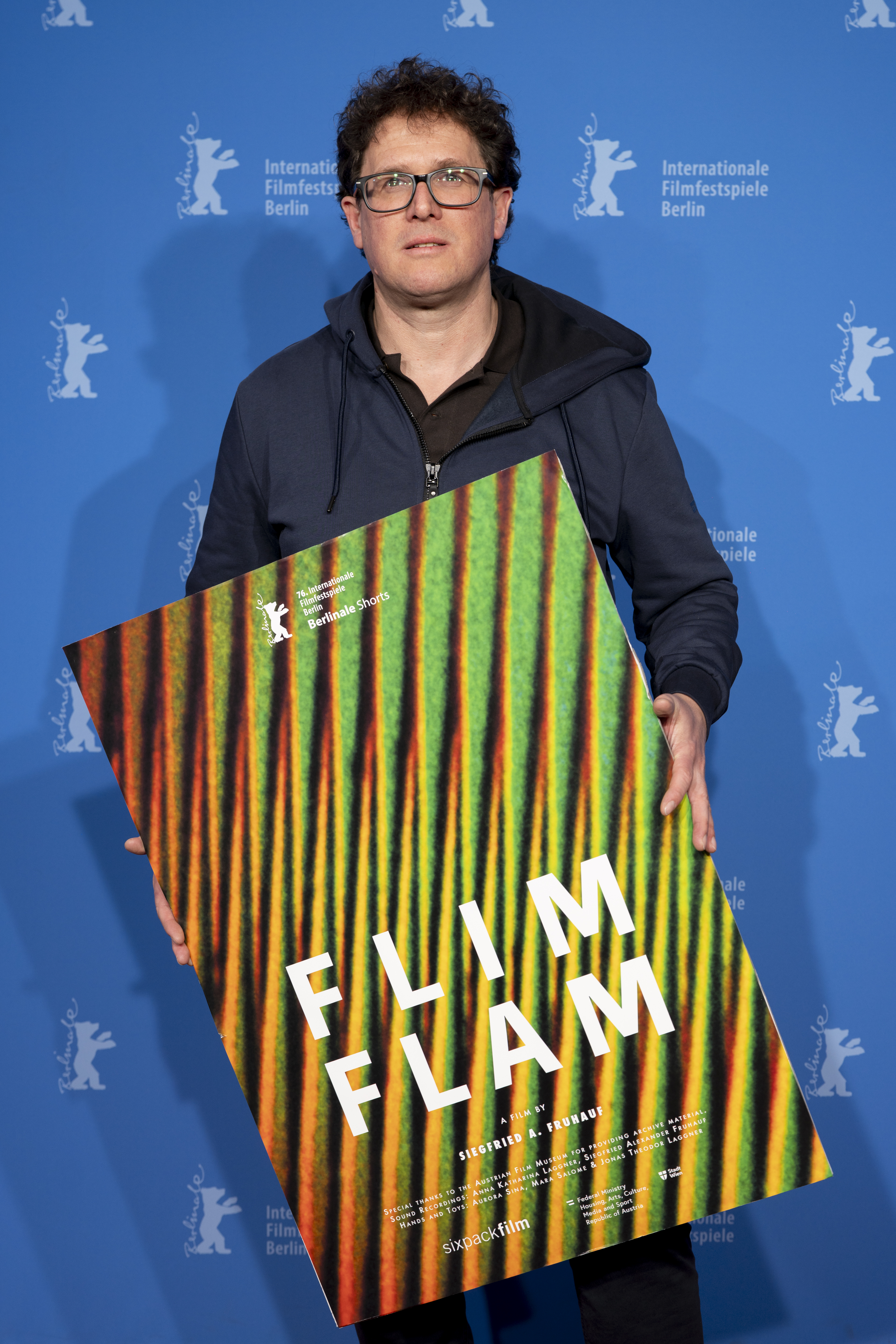
Born in Grieskirchen, Austria in 1976, Siegfried A. Fruhauf studied experimental visual design at the University of Art and Industrial Design in Linz, where he has also taught since 2009. His films have screened at festivals including Cannes, Venice and Sundance. Vintage Print was selected for Berlinale Shorts in 2016. In 2018, he received the Austrian Art Prize in the film category. He lives and works in Vienna and Heiligenberg.
What was your starting point for „Flim Flam“?
At the beginning of my project FLIM FLAM, there were in fact no photographic images, but graphic visual material. I derived this material from apparatuses of text production. Specifically, I worked with a mechanical typewriter, an Olivetti Lettera 40, and a dot matrix printer, a Fujitsu DL-1150. I pursued a dadaist approach that consisted of focusing on patterns composed exclusively of the punctuation mark “!”. These “texts” were layered using both mechanical printing processes and digital methods, and the resulting image series were then reassembled into moving-image sequences using a frame by frame technique. This process produces moiré effects that can be read both as visual disturbances and as aesthetic phenomena. Lines meet lines, structures meet structures, and new forms emerge, disrupting habitual systems of meaning and reducing the punctuation mark to its formal core value. In the film, the punctuation mark appears as what it essentially is, stroke and dot, the elemental building blocks of every drawing. Yet the culturally learned semantic charge can never be completely suppressed. Stroke and dot are inevitably read as signs, and their semantic meaning remains active. An inverted exclamation mark transforms into an “i”, perhaps a subtle reference to „information“, perhaps to „illusion“, or perhaps to both at once.
This approach corresponds to a playful exploration of media inherent properties and finds a theoretical framework in the concept of remediation. Throughout the diverse forms of moving-image representation, processes of mutual influence and interpenetration have always been at work. Cinema has influenced television, which in turn feeds back into cinema. Avant-garde film has shaped the music video, early camera movements, phantom rides, have influenced video games, and so on. These interrelations are deeply embedded in my artistic practice. The interplay between a wide range of image producing techniques is a central driving force in my film production and fuels my visual urge for discovery, not entirely without irony. A slight wink is therefore welcome. As an umbrella term and working title for this approach, I like to use the word DIGIDADA. Although my starting points are often analog film material and physical image sources, I understand my generation as having been socially and culturally shaped during a medial transition between analog and digital culture. From this emerges my specific way of mixing, translating, and layering different moving-image carriers. The motivation behind this work is nothing less than to create a form of concrete poetry on a cinematic level in order to approach what can no longer be conveyed through language, text, or realistic representation. In this way, I hope to make perceptible something of what makes us human.
Do you have a favorite moment in the film? Which one and why this one in particular?
The most important moments in this film are those in which something becomes visible that does not actually exist on the cinema screen itself and arises only in our minds, an optical illusion. These are moments in which we inscribe ourselves into the film through our own perceptual capacities.
On the cinema screen, whose enlarged material structure is made visible at the beginning of FLIM FLAM, there is no real movement. The impression of movement arises entirely through processing in the human visual system. Film is a medium that thrives on illusion, and it is precisely through this that it opens up a distinct form of truth. For in the intensity of visual experience, at the threshold of what can be physically sensed, what film is capable of showing becomes a mirror of perception itself. This experience unfolds in the film through rotating lines and interference structures and culminates in dense superimpositions of black and white patterns formed from a single typographic character.
In contrast, those opposing scenes gain particular significance, moments in which the medium makes visible something that does exist, yet we cannot perceive it through our naturally given perceptual abilities. The zebra in my film, a horse-like ungulate, stands not only for a biological strategy of deception but also points to a media-historical trace, Eadweard Muybridge’s galloping horse, that iconic image moment which in pre-cinematic experiments first demonstrated the brief suspension of the animal during the gallop. An evidence produced through photographic motion analysis for a previously invisible fact, a truth that became visible only through the technical image.
Within this field of tension, my favorite image of the film emerges, that of children at play. Children’s hands reach for objects, yet they do more than merely grasp. They feel, explore, comprehend in the most literal sense. In play, grasping becomes a form of thinking with the fingers. The hands do not only hold, they protect, enclose, shape, an ambivalent gesture, tender and at the same time potentially controlling. The toy thus becomes a medium of imagination. It is both miniature and metaphor, a condensed version of the larger world, a model that makes reality tangible. In play, the boundaries between the real and the imagined, between what is and what could be, begin to shift. In this sense, the images at the end of the film are for me the most beautiful moment.
What do you like about the short form?
In my work, I repeatedly refer to the history of cinema, not least because it began with the short film. It is precisely in this early phase that it becomes especially clear where the true fascination of moving images lies and what constitutes the essence of the cinematic. For me, the short form is therefore not merely a formal decision but an attitude. When asked why I value it so highly, I always arrive at the same answer. I understand myself as a kind of distiller of cinematic essences. My working method resembles that of a distiller of spirits. It is about concentration, condensation, and achieving the highest possible intensity. This does not exclude longer forms. However, since I consciously avoid classical narrative structures and work with visually dense and demanding experiences, the short film appears to me, particularly in the context of cinema, to be the most precise and perhaps even the most necessary form.
*************************************************************************************
PRESS / REVIEWS / INTERVIEWS
„The shape, dimension and patterns of a zebra power the chaotic, ever-changing animations of Siegfried A. Fruhauf’s experimental work (feature image), which plays with hallucinogenic imagery in a visceral, instant fashion.“
review in Journey Into Cinema
„Um ein Kino der Attraktionen geht es Fruhauf nicht zwingend, wohl aber um eine phänomenologisch aufgesattelte Durchleuchtung der filmischen Form. Ein galoppierendes Zebra, das mehrmals im Film in unterschiedlichen Aggregatszuständen und Bildraten auftritt, verweist auf die präfilmischen Anfänge des Bewegtbildes, die Experimente von Eadweard Muybridge und Konsorten.“
review in critic.de
„Flim Flam erinnert mit der Schnelligkeit der Einzelframes und Schnitte, mit dem inflationären „!“ an die Herstellung von Texten und optischer Tiefe, die zu sinnstiftenden Narrativen transformiert werden.“
review in NIGHT OUT @ BERLIN
 Berlinale Shorts