
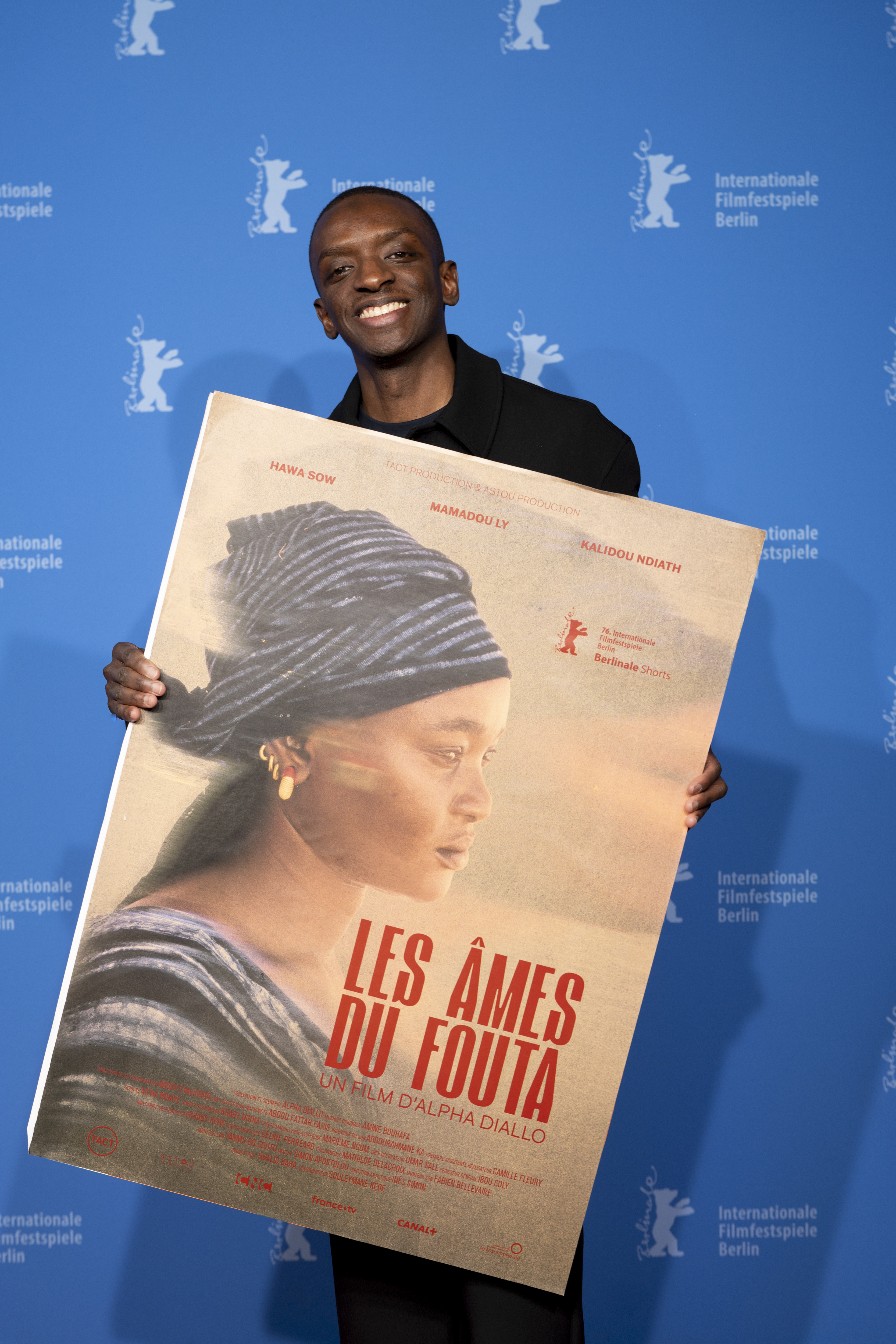
Born in Paris, France in 1991, the screenwriter and director Alpha Diallo is of Senegalese origin. He studied history at the Sorbonne and has also participated in various writing programmes and residencies. Les âmes du Fouta is his first short film.
What was your starting point for „Les âmes du Fouta“?
In August 2006, when I was fourteen, I traveled to Senegal, my country of origin, for the first time. During this trip, I met my entire fulani family and spent a month in my parent’s native village, in the north of the country, in a region known as the Fouta. There, I learned of the death of my cousin’s best friend from a drug overdose. He was sixteen years old. Members of his family refused to bury him in the village cemetery, claiming that his soul was “impure”. I remember, in the midst of adolescence, this tragedy deeply shook me. I had never before been confronted with the death of a boy from my own generation. I strongly identified with him, without ever having known him. This story, where his family out of shame, did not bury him alongside their own, tore me apart.
Nearly ten years later, in 2015, I returned to Senegal. I was able to see my parent’s village no longer through the eyes of an adolescent, but as a young adult facing the world. Once again with my cousin, he told me how the death of his best friend had changed him and altered his way of seeing the world. He spoke to me at length about mercy and love. I could see the path we had traveled, from adolescence to young adulthood, with greater maturity and perspective. At the same time, I was beginning my journey in the world of cinema, first through writing, then directing. And I kept this story in mind, this tragedy carrying a powerful message of hope.
I began writing the short film in 2020, with sorrow, and suffering as its guiding thread. It was a long process of stripping the writing down to its core, during which I divided the story into three chapters : incomprehension, doubt, and liberation.
Do you have a favorite moment in the film? Which one and why this one in particular?
If I had to choose, I would point to the moment of Penda’s departure. It may seem like an escape, but through this act she confronts indirectly the judgment and the decision of her husband Moustapha. She throws him a challenge, and over the course of one night, a kind of confrontation, or long-distance dialogue between them. Despite the urgency of the situation, she remains calm, even though one can feel the fire gradually rising within her. Her journey traces an emotional arc that mattered deeply to me : grief, incomprehension, anger, revolt, leading to an explosion.
I also like this moment because it’s the film’s turning point. We know that this gesture will have consequences for her and for others.
What do you like about the short form?
The short film format requires conveying a certain amount of information and emotion in a very limited time. It demands concision and a clear understanding of what we want to tell and transmit to the audience. And precisely, it’s this constraint that appeals to me, because it calls for extreme precision in the writing, directing, and work with actors.
*************************************************************************************
PRESS / REVIEWS / INTERVIEWS
„En lice pour l’Ours d’Or du court-métrage, on trouve notamment Les Âmes du Fouta, réalisé par Alpha Diallo. Ce trentenaire élevé en France, né de parents sénégalais, a tourné dans le nord du Sénégal l’histoire d’une mère se battant pour enterrer son fils, mort d’une overdose à Dakar. „
article in RFI
„Il est la nouvelle sensation du septième art sénégalais. Révélé au grand public international lors de la dernière Berlinale, Alpha Diallo est bien plus qu’un réalisateur : c’est un raconteur d’histoires hors pair.“
article in SenePlus
„Alpha Dialo erzählt die Geschichte nach Art einer Novelle mit wenigen Worten und umso eindringlicheren Gesten und Landschaftseinstellungen (Kamera: Nader Chalhoub).“
review in NIGHT OUT @ BERLIN
„“C’est un film qui trace le parcours d’une famille peul qui reçoit le corps de son enfant, sauf que la cause de la mort de ce dernier (overdose) est jugée déshonorante. Le père décide alors de ne pas enterrer cette âme impure au cimetière du village, tandis que sa mère exige le contraire”, résume le réalisateur.“
article and interview on AllAfrica
„Diallo’s work reflects a growing trend of Senegalese filmmakers gaining international acclaim. He highlighted the success of other Senegalese directors, such as Mati Diop and Ramatoulaye Sy, whose films have been featured at major festivals“
article and interview in World Today Journal
„2 films sénégalais en Compétition officielle au 2ème plus grand festival du monde : DAO (10ème film d’Alain GOMIS) et LES AMES DU FOUTA (1er court d’Alpha DIALLO)“
mention in Le site cinéma et images de la Francophonie
 Berlinale Shorts