
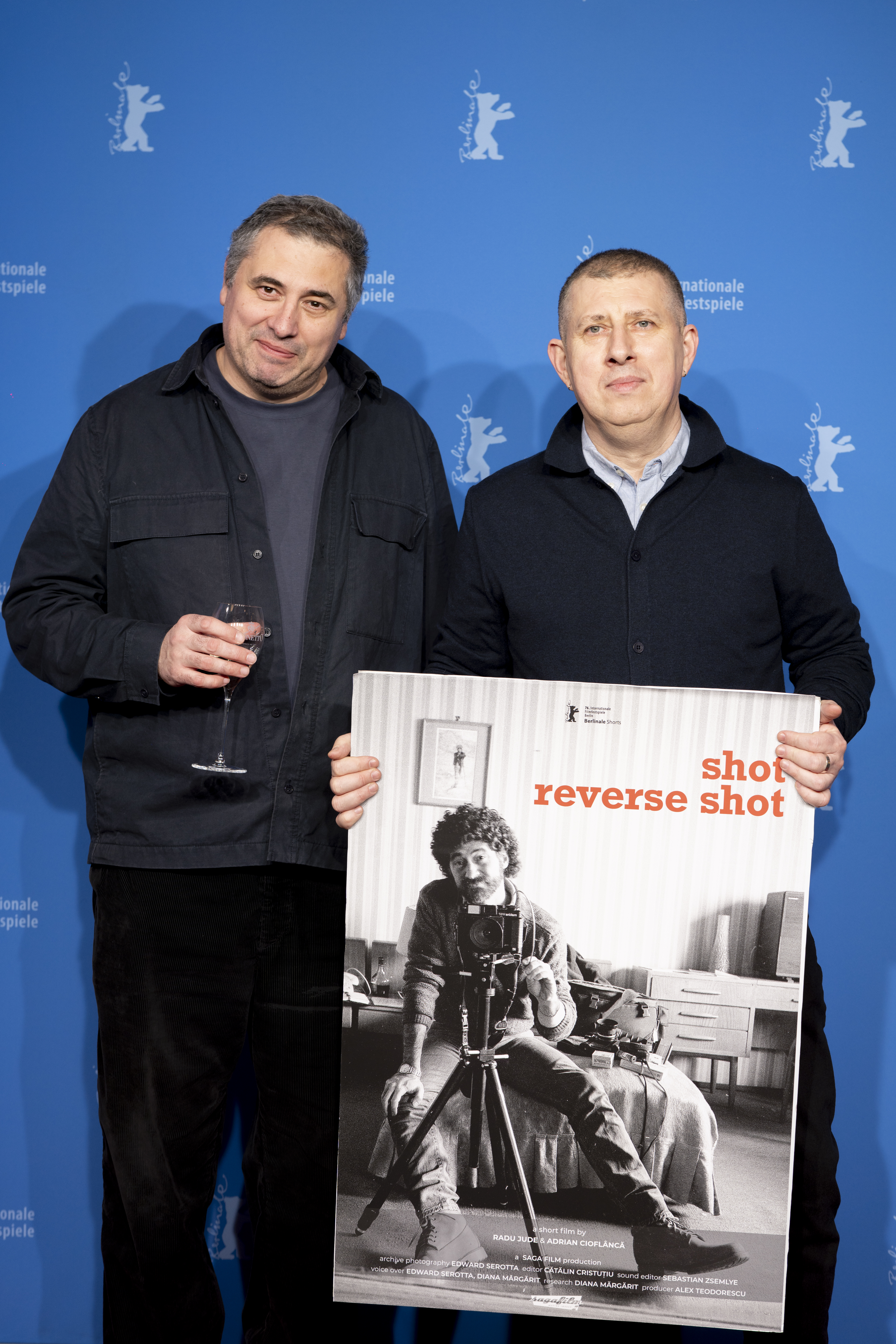
The work of the Romanian film director and screenwriter Radu Jude has already been presented a number of times at the Berlinale, most recently in 2025 with the low-budget independent production Kontinental ’25 which won the Silver Bear for Best Screenplay. Bad Luck Banging or Loony Porn was likewise selected for the Competition and won the Golden Bear for Best Film. In 2023, he was a member of the festival’s International Jury.
Born in Piatra Neamț, Romania in 1974, the research of historian Adrian Cioflâncă focuses chiefly on the Holocaust, communism and political violence. He is the director of the Wilhelm Filderman Center for the Study of Jewish History in Romania and has also worked as a consultant on several film and theatre productions based on historical subject matters. His documentary The Exit of the Trains had its world premiere in the Forum section of the Berlinale. It was followed by Memories from the Eastern Front, a collaboration with Radu Jude with which he was first invited to Berlinale Shorts in 2022. Plan contraplan is the third project he has co-directed with Jude.
What was your starting point for „Plan contraplan“?
Adrian: We have known Edward Serotta for many years. He visited Romania multiple times and carried out projects in the country as the director of Centropa, an organization that has collected oral history interviews and photographs documenting Jewish life in the 20th century. We knew that he had taken photographs in Romania in the 1980s, and we had seen his collection at the Library of Congress, in Washington. Edward wanted to see his Securitate file, which is now held by the National Council for the Study of the Securitate Archives and thus we learned that the Securitate had closely surveilled him during his three visits to Romania and had taken many photographs of him. This is how the idea of shot and reverse shot emerged. We started to work on the idea of a film during the pandemic. Not all short films are made in short periods of time. We extracted from the surveillance files all references to moments when Serotta took photographs while visiting Bucharest and other cities in the country and asked him whether he could identify the photographs. He responded promptly, arranging in two columns each reference to photographs and the photographs he had taken. From this rich and striking material, we made a selection.
Radu: For me it was a proposal from Adrian (and he always has good ideas). We share not only an interest in history (he is a professional, me – an imposter) but, if I may, in the comic side of History. And in this small story we have, I think, a mix of the drama of Romania in the ’80’s coupled with the comic of history.
Do you have a favorite moment in the film? Which one and why this one in particular?
Adrian: The Securitate’s unintentional humor is unparalleled.
Radu: No, I never have and never had for any of my films. For me every moment in the film has the same importance as any other, despite the fact that some scenes are always better than others. I hope the film is good or at least watchable in its entirety.
What do you like about the short form?
Adrian: The short form has multiple benefits at minimal costs. After all, this film had a budget close to zero. The short form forces you to tell a story in a concise, synthetic version. This is not a treaty about Romania in the 80s or Serotta’s biography. Instead, it is a cut through two intersecting visual narratives on a country under dictatorship.
Radu: I agree with Adrian here and I would add this Zen proverb: “In the spring scenery there is nothing superior, nothing inferior; flowering branches grow naturally, some short, some long.”
*************************************************************************************
PRESS / REVIEWS / INTERVIEWS
„The structure of Shot Reverse Shot is built around the idea of presenting two distinct narratives across from one another, exploring how one image informs the other. Rather than creating a more expansive documentary with a multimedia approach, Jude and Cioflâncă take a far simpler direction, looking almost exclusively at the photographs produced by the two parties.“
review in International Cinephile Society
„Prima discuție despre film am avut-o în septembrie 2018, când i-am povestit lui Radu despre ce am descoperit în dosarul de urmărire al Securității despre Serotta, iar lui i s-a părut o idee bună să iasă un film de acolo.“
interview in Scena9
„Plan contraplan (Shot Reverse Shot) feels strikingly urgent, connecting past and present while probing the enduring echoes of political oversight and the ways history is seen, recorded, and interpreted.“
review in Curation Hour
„Regular attendee Radu Jude teamed up once again with historian Adrian Cioflâncă and entered a short film. Plan contraplan/ Shot Reverse Shot uses archival photographic material (my favourite genre of Jude films) and explores both theories of seeing and footage of Jewish life in communist Romania.“
review in Romania Insider
„Was Plan contraplan (englischer Titel: Shot Reverse Shot) zu einem guten Film über eine gute Reisegeschichte macht, ist die Gegenüberstellung von Serottas dokumentarischen Arbeiten mit einem anderen Bildkorpus.“
Review in critic.de
„Le génial réalisateur roumain Radu Jude (Ours d’or avec Bad Luck Banging or Loony Porn) fait équipe avec son compatriote Adrian Cioflâncă pour ce court métrage qui explore avec esprit l’Histoire et sa mise en scène. Ces différentes perspectives suggèrent les récits cachés derrière des images frappantes, avec un silence magnétique qui développe un puissant sentiment d’intimité.“
review in Le Polyester
„Radu Jude erzeugt die Komik in Plan contraplan durch die Gegenüberstellung der Fotos und Erzählungen. Die Staatslüge der rumänischen Sicherheitsbehörde wird nicht zuletzt durch ein bestimmtes Vokabular und eine wiederkehrende Syntax entlarvt.“
review in NIGHT OUT @ BERLIN
„Serotta wollte trotzdem in das osteuropäische Land, musste vorher versichern, dass seine Absichten nur positiv seien und er nichts negatives zeigen würde. Zwei Jahre umfassen seine Aufnahmen, die in dem Kurzfilm Plan Contraplan von Radu Jude und Adrian Cioflâncă auf der Berlinale gezeigt werden.“
review in Jüdische Allgemeine
„Contrastul dintre „plan” și „contraplan” este fascinant pentru spectatori, care au acces la două perspective diferite, dar complementare, asupra unei epoci revizitate, în spiritul lui Eco, „cu ironie, fără candoare”.“
review in Adevarul
 Berlinale Shorts